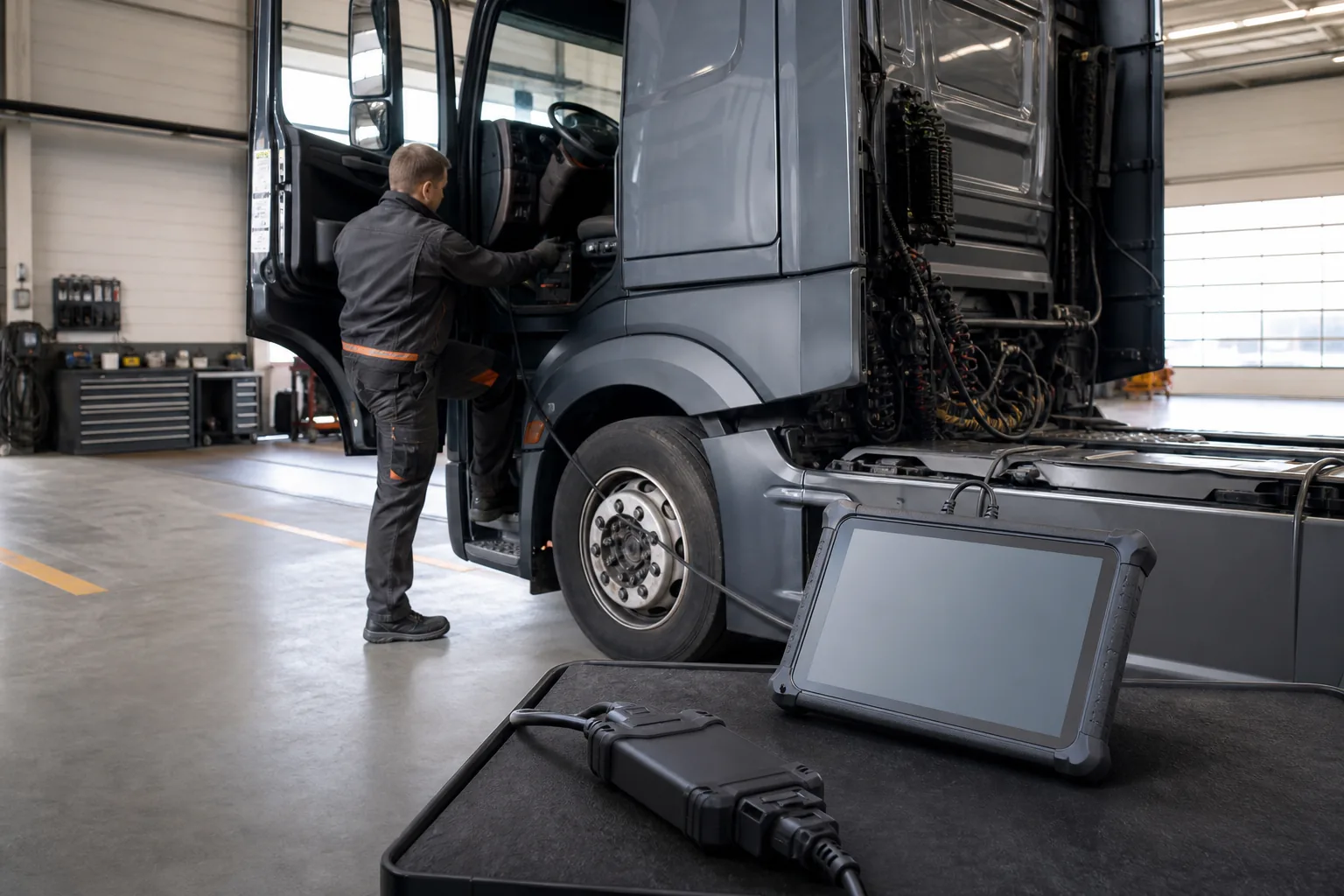
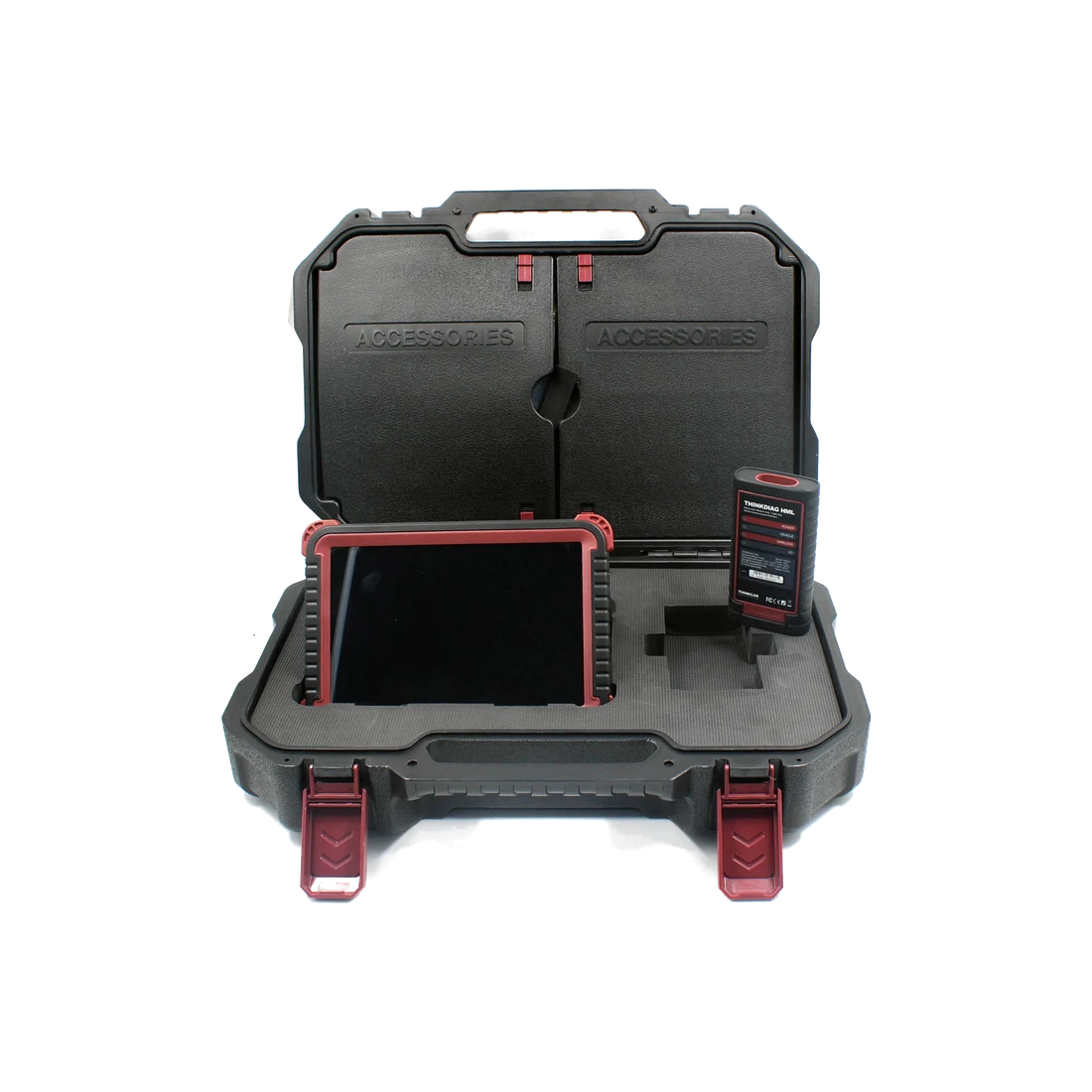
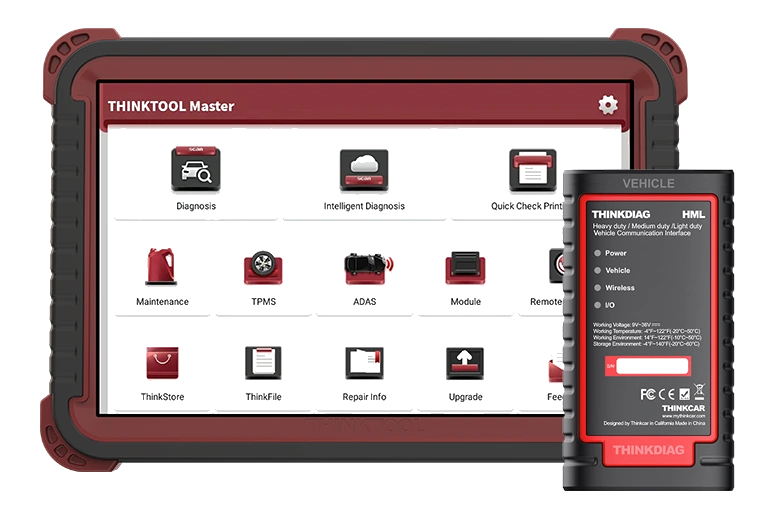
Selecting a heavy-duty diagnostic tool is not just about plugging a different cable into a passenger car tablet. Trucks, tractors, buses, trailers, construction machinery, and agricultural vehicles may use different control units, sockets, voltage levels, and software packages. SAE J1939 is a common communication family in heavy-duty vehicles; however, it does not fully explain all diagnostic functions for every brand and system. The correct device must accommodate the service's actual vehicle fleet, 12/24 volt hardware, cable set, engine and chassis coverage, DPF/SCR operations, reporting, and update costs within the same selection.
Is the target brand's socket included in the package?
Package parts list
Cannot physically connect to the vehicle
Action
Code, live data, test, calibration?
Model-system coverage
Insufficient service depth
Decision guide
Why is heavy-duty diagnostic coverage evaluated separately?
A heavy-duty vehicle is not a single vehicle type. Long-haul tractors, city buses, light trucks, trailers, construction machinery, and agricultural equipment have different electronic architectures. Engine, transmission, retarder, ABS/EBS, SCR, body, cabin, and trailer control units may come from different manufacturers. Device coverage is evaluated based on component manufacturers and systems as much as vehicle brands.
In a tractor, the engine may use a control unit from one manufacturer, the transmission from another, and the brake system from a third supplier. The device listing the vehicle brand does not prove access to all subsystems with the same depth. While engine codes can be read, EBS active tests or trailer system coverage may be excluded.
The SAE J1939 family offers a common architecture for data exchange between electronic control units in heavy-duty environments. The current J1939 main framework document covers commercial vehicles, construction machinery, and related applications. J1939/73 addresses diagnostic messages and service interfaces. However, brand-specific parameters and operations require device software.
The service should first classify the fleet it serves: brand, model, year, engine, transmission, brake system, and auxiliary equipment. Work orders from the last six months indicate which systems are actually revenue-generating. Device selection should start from this table, not from the number of brands in the catalog.
Visual summaryHeavy-Duty Diagnostic Coverage
Technical signals
01
Engine and EmissionsInjection, DPF, SCR, and related sensors
02
TransmissionGear control and adaptations
03
Brakes and ChassisEBS/ABS, suspension, and trailer
04
Body SystemsCabin and manufacturer-specific modules
Accessing only the engine ECU in a truck does not meet the entire service needs of the fleet.
Decision guide
Why is 12-volt and 24-volt support critical?
While most passenger cars use a 12-volt electrical system, 24 volts is common in heavy-duty vehicles. The diagnostic VCI, cable, and accessories must safely support the target voltage. Connecting an unknown adapter designed for 12 volts to a 24-volt socket can cause hardware damage and vehicle communication issues. The manufacturer's technical voltage range must be clearly verified.
The series connection and chassis structure of vehicle batteries are checked. Weak batteries can cause voltage drops during starting and high consumption, interrupting communication. System voltage is measured before diagnostics begin. A suitable 24-volt power supply may be separate equipment for programming or long active tests.
In systems where the VCI is powered by the OBD socket, the pin and voltage must come through the correct cable. For older round brand sockets, the adapter may carry the power supply separately. Universal extension cables or homemade connections should not be used without knowing the cable pin structure.
The tablet charging adapter should not be confused with the vehicle VCI power supply. If an inverter and extension are used in service vehicles or roadside assistance, electrical safety must be ensured. Wet, dusty, and vibrating environments are evaluated separately for device durability.
VCI Voltage Range
12/24 V Cable Compatibility
Battery and Chassis Check
Programming power support
Decision guide
What does J1939 standardize?
SAE J1939 is a family of standards used for data exchange between electronic control units in heavy-duty vehicles. It has different sub-documents covering message structure, network management, diagnostic services, and physical connections. On the diagnostic side, data such as active fault codes, lamp status, parameters, and control unit information can be transmitted.
J1939/73 defines the transmission of diagnostic messages to the service vehicle and the use of diagnostic connectors. Definitions like SPN and FMI can be seen on the network: SPN refers to the suspect parameter, and FMI refers to the type of fault. The device can translate these into user language; however, a manufacturer's test plan is still required.
J1939/13 defines the off-board diagnostic connector for heavy-duty vehicles. Six-pin, nine-pin, or manufacturer-specific connections may be encountered in the field. The physical resemblance of the connector does not guarantee pin and speed compatibility. The correct cable part number must be used.
J1939 support does not mean the device will perform coding or programming on every heavy-duty brand. In addition to standard messages, manufacturer-specific services may exist. Protocol support and brand-system functions should be shown separately on the product page.
Visual summaryJ1939 support and brand coverage are not the same
01
J1939 LayerNetwork communication and standardized message infrastructure
02
Brand SoftwareECU recognition, proprietary codes, tests, and procedures
The ability to communicate via the protocol does not prove that the specific tests and calibrations in every control unit are supported.
Decision guide
How to plan the cable and adapter set?
The usability of a heavy-duty device in the field is often determined by the cable set. In addition to the standard J1939 connection, different sockets may be required for Mercedes-Benz, MAN, Volvo, Scania, Iveco, Renault Trucks, DAF, or construction machinery manufacturers. The package contents are not to be guessed from the photo; the name and part number of each cable are listed.
Instead of paying for dozens of unused cables in the service's vehicle fleet, the necessary brand set can be selected. Conversely, a missing adapter for a frequently encountered older model vehicle will render the device inoperable. The fleet list prioritizes cable investment.
Cables should be labeled, stored neatly, and checked for pin damage. Pins forced into the wrong socket can create communication or short-circuit risks in the vehicle's control unit. Long extension cables and splitters can affect signal quality; external additions not from the manufacturer should not be used.
Roadside assistance should include a multimeter, fuse information, and appropriate power support along with the cable bag. When physical connection cannot be established, socket supply and chassis are checked before discussing protocol or software.
Decision guide
Engine, transmission, and brake system coverage
The primary expectation of heavy-duty service is access to engine, automated transmission, and ABS/EBS systems. The device should offer error codes, ECU identification, live data, and supported active tests for these modules. Retarder, suspension, cabin, and trailer systems are added according to the business model.
In engine diagnostics, fuel pressure, turbo, exhaust temperature, DPF/SCR, and NOx data may be important. Code descriptions are not part replacements; they must be verified with live data, electrical, and mechanical measurements. Operating conditions and load information are added to the report for heavy-duty engines.
Parameters such as clutch wear, gear selector, and air pressure may be available in the transmission depending on the system type. Learning after clutch calibration or component replacement requires manufacturer procedures. The presence of a menu does not guarantee the same operation across all transmission variants.
ABS/EBS brake systems are critical for safety. Error codes, wheel speeds, pressures, and modulator tests are evaluated by trained personnel. Trailer and tractor systems may have separate control units; connection and test procedures are planned according to the vehicle combination.
Visual summaryHeavy-Duty Hardware Check
01
12/24 volt VCIHardware suitable for the vehicle's electrical system
02
Socket FamilyBrands and vehicle types in the fleet
03
Cable DurabilityConnection suitable for workshop conditions
04
Tablet and PowerSufficient durability for long tests
Incorrect voltage or missing socket adapter can halt the job, even with good software coverage.
Decision guide
What to expect from the device for DPF, SCR, and AdBlue operations?
On heavy-duty vehicles with Euro emission levels, DPF, SCR, AdBlue dosage, and NOx sensors are a significant part of the service. The device should display not only error codes but also differential pressure, exhaust temperatures, soot load, dosage status, and sensor data. Regeneration and post-part adaptation must be verified separately in the manufacturer's current function list for the relevant brand-model.
DPF regeneration is not initiated with every warning. Engine faults, filter load, temperature, and safety conditions preventing regeneration are checked. Stationary regeneration on heavy-duty engines can generate high exhaust temperatures and long processing times; an open, controlled area is required.
To find the root cause of SCR faults, AdBlue quality, dosing unit, heating, pressure, NOx sensors, and exhaust leaks are checked sequentially. Clearing codes does not resolve the root cause of torque limitation or countdown. System integrity related to manufacturer procedures and regulations is maintained.
Resetting or quality testing after part replacement varies by vehicle model. Even if the device's 'aftertreatment' menu is visible, the relevant function must be checked on the target engine ECU. Software and licenses are kept up-to-date.
Decision guide
Is support for construction machinery and agricultural vehicles separate?
Construction machinery and agricultural vehicles may use J1939-based communication, but the vehicle structure and manufacturer software may differ from truck packages. Brand and model coverage for excavators, loaders, tractors, generators, or industrial engines must be inquired separately. A 'heavy-duty' package does not automatically cover all off-highway vehicles.
Auxiliary equipment and hydraulic control units on vehicles may be manufacturer-specific. Connecting to the engine ECU does not mean access to all systems of the machine. Moving booms, hydraulic valves, or power take-offs during active tests pose serious physical risks; a safe working area is mandatory.
Dust, moisture, temperature, and field vibration affect device protection. A robust carrying case, replaceable cables, and screen visibility are important. IP protection class claims should only be used if manufacturer technical data is available.
For vehicles in remote areas, offline software operation and license verification behavior should be checked. A mobile internet plan may be required for cloud-based functions. Transferring service records to the center provides value in fleet management.
Visual summaryStart the investment decision from the vehicle fleet
01
List the vehicle fleetBrand, model, year, and type of use
02
Write the job listScan, DPF/SCR, calibration, and report
03
Prove the scopeCurrent manufacturer record and cable contents
04
Test on a pilot vehicleActual connection and operation time
Instead of the highest number of features, the actual jobs that can be completed on the vehicles regularly seen by the service are measured.
Decision guide
Hardware selection for workshop and mobile service
In the workshop, large screen, printer, reporting, stable power supply, and computer integration may be prioritized. For mobile service, durability, battery life, wireless VCI, carrying case, and offline access become important. If the same device will be used in both environments, the cable arrangement and charging plan should be established.
A 10-inch class tablet can facilitate reading schematics and multiple live data streams. Screen size alone is not performance; processor, memory, software speed, and VCI connection determine the actual experience. Use with gloves and visibility in sunlight should be tested during a field demo.
Wireless VCI provides ease of movement around long vehicles. However, metal cabins, distance, and radio interference can affect the connection. For critical calibration or programming, the manufacturer's recommended wired connection is used. A workflow is established to prevent the VCI from being forgotten on the vehicle.
Reporting is valuable for fleet customers. Vehicle identification, mileage/hours, initial-final codes, and the performed operation are recorded. The printer module or PDF export is selected based on the device ecosystem. Customer data is stored securely.
Decision guide
Software, license, and total cost of ownership
The purchase price of a heavy-duty device includes brand packages, annual updates, online services, additional cables, technical information, and training costs. Some devices require separate licenses for passenger car and heavy-duty software. The operating status after the update period of existing software should be checked from the contract.
Coverage of new emission systems and control units depends on updates. The age distribution of vehicles in the service determines the update value. An operation with a predominantly older fleet will invest differently than one with new Euro VI vehicles.
Online programming or remote expert services may require per-transaction credits. This cost is included in customer pricing. The account region and device serial number must match; licenses with an unclear source are not sustainable.
Technical support should be accessible not only for installation but also for actual vehicle coverage and connection issues. Turkish support, remote connection requirements, and operating hours should be asked before purchase; unverified support promises should not appear on the product page.
Decision guide
Heavy-duty vehicle checklist before purchase
Select ten actual vehicles from your service and list the brand, model, year, engine, transmission, brake system, and socket. For each, separately mark the requirements for code reading, live data, active tests, DPF or SCR, calibration, and programming. Check these vehicles in the manufacturer's current vehicle and function list.
Verify the VCI's 12/24 volt range, J1939 and other required protocols, cable set, and adapter part numbers. Obtain a written delivery list instead of a package photo. The cost of missing cables should be added to the total budget.
On a demo vehicle, perform a general scan, one live data graph, and a safe active test. Evaluate the report's readability in Turkish, software speed, and module coverage. The tested vehicle, software version, and results should be recorded in writing.
The right device is not a product that 'works on all trucks'; it is a solution that highly matches the service's actual vehicle and operation list, has safe 12/24 volt hardware, correct cables, sustainable software, and accessible support.
Decision guide
Standard diagnostic report for fleet customers
In fleet operations, the device's value goes beyond connecting a single vehicle to producing consistent reports. At each acceptance, vehicle identification, mileage or operating hours, engine and chassis ECU information, active/passive codes, emission system status, and driver complaints are recorded in the same format. This allows tracking recurring faults, trends between vehicles, and post-maintenance changes.
The initial report is obtained without deleting codes. After the approved diagnosis and repair are completed, the final report, live data, or test results are added. If DPF regeneration was performed, initial and final data are included; if calibration was performed, the operation status is written. A record of 'fault cleared' alone is not sufficient for fleet maintenance decisions.
The report can be presented to the customer as an understandable summary and technical appendix. SPN/FMI or manufacturer codes are preserved, with the affected system and recommended next check written alongside. A definitive part decision cannot be made without measurement. Vehicle license plate, VIN, and driver information are stored securely.
When selecting a device, test PDF creation, printer integration, historical record search, and data sharing with the center. The ability to transfer reports taken offline in the field once a connection is available is important for mobile service. This workflow transforms device investment into measurable service.
Frequently Asked Questions
Most frequently asked questions by customers
Can a passenger car device be used on heavy-duty vehicles?
Some platforms can be expanded with additional heavy-duty VCI, software, and cables. A standard passenger car VCI should not be connected without verifying its support for 24 volts and heavy-duty protocols.
Does J1939 support cover all trucks?
No. J1939 is an important communication standard; brand, model, system, and specific service function coverage depend on the device software.
Why is 24 volts important in a heavy-duty device?
Many trucks and buses use 24-volt systems. If the VCI and cable do not have the appropriate voltage range, communication problems or hardware damage may occur.
Does a device with DPF regeneration work on every heavy-duty vehicle?
No. Engine ECU, emission system, model-year, and software coverage vary. It must be verified along with live data and safety preconditions.
Which cables should I get?
The vehicle brands, model years, and sockets in your service should be listed; only the manufacturer-specified cables and adapters for these vehicles should be selected.