Product information
What is the THINKPPS 150 used for?
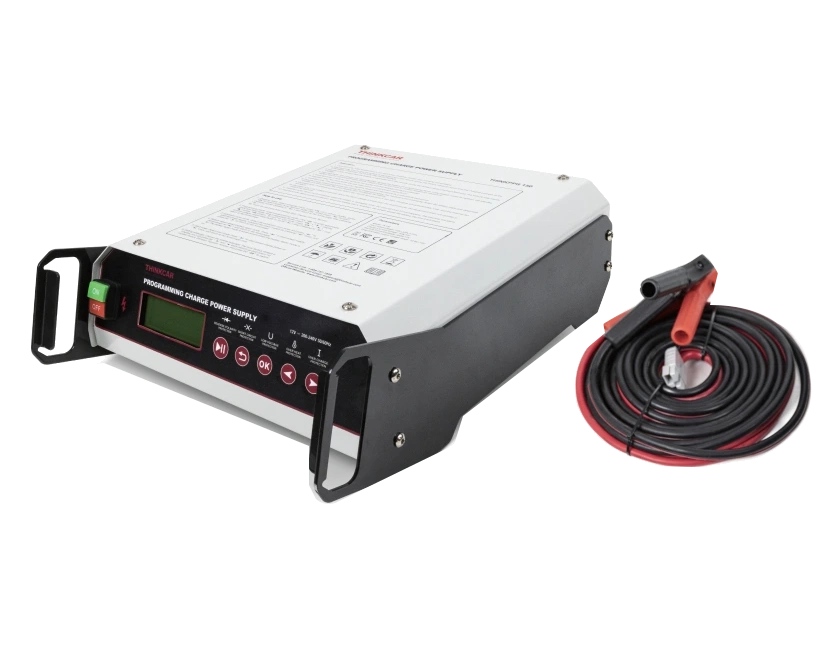
The THINKPPS 150 is a workshop power supply used to provide a stable electrical supply to a vehicle when the diagnostic tool is installing software. The programming output is in the range of 10.8–15 V. It also includes different modes for 12 V battery charging, manufacturer-supported battery maintenance, display supply, and jump-starting assistance.
This device does not install ECU software; the diagnostic tool performing the operation, the license, and the vehicle connection are separate. A connection method that replaces the battery during programming is not assumed: the manufacturer's manual requires the vehicle battery to remain connected. The number 150 in the model name does not mean a continuous 150 A output is provided in all modes.
Vehicle and part coverage
What vehicles is the THINKPPS 150 used for?
A make-model software list, as found in diagnostic devices, does not apply to this product. Compatibility is determined by the part to be measured, the electrical system, the operating range, the probe or connection method, and the manufacturer's safety limits.
- Vehicle make
- Evaluated not by brand, but by the product's technical measurement or service limit.
- Vehicle model
- Further evaluated if the system to be measured and connection condition are within the technical range.
- Technical limitation
- 10.8–15 V programming supply, 20 A / 12 V charging, 400 A / 12 V jump-start support, Independent power supply
- Diagnostic Scope
- Does not include vehicle control unit software or make-specific service menus.
- Measurement range and safe connection conditions are verified from the product's official technical documentation.
Open official sources and coverage connectionsProduct details
Why is a separate power supply used during programming?
When software is transferred to a control unit, the ignition may remain on, and other electrical consumers in the vehicle may also be active. Monitoring the battery voltage throughout the operation is therefore important. The programming supply meets a different need than a normal battery charging process: stable voltage support within the range specified by the vehicle manufacturer.
Having a power supply alone does not make software installation safe or successful. The battery's condition, terminal connection, mains supply, diagnostic interface, and the conditions of the software to be used are also checked. The voltage and continuous load required by the vehicle procedure must be within the device's relevant mode limits.
Equipment is not selected based solely on the model number without verifying the required current for a specific vehicle.
Product details
Five operating purposes are not the same output value
Programming, charging, battery activation/maintenance, display, and jump-start support are different tasks. Voltage stability is critical in programming mode; in charging mode, appropriate charging behavior for the battery type is required. The specified high current in jump-start support pertains to the short-term starting need.
Therefore, the 400 A jump-start value cannot be read as a value that can be continuously used in ECU programming. Similarly, the 20 A charging line does not define all modes. The appropriate mode for the operation is selected on the panel, and the limits in the manual are followed. Random switching between maintenance or repair modes for testing purposes while the vehicle is connected is not performed.
- Programming supply
- 10.8–15 V
- Charging current / voltage
- 20 A / 12 V
- Jump-start current / voltage
- 400 A / 12 VJump-start support value; not continuous programming current.
- Input
- 110 V ±15% or 220 V ±15%; 50/60 Hz
- Rated input power
- 3.8 kVA
- Enclosure protection class
- IP21S
Product details
Service scenario: installing software on a control unit
For a vehicle arriving at the service for control unit replacement, the part number and programming method of the new module are first determined. The technician checks the manufacturer's supply requirements; if the vehicle battery and connection points are not suitable, they do not start the installation. The PPS power supply only undertakes the energy support task.
If it is a Thinktool or another compatible programming system, it performs the software transfer. During the operation, electrical consumers are managed according to the vehicle procedure, voltage is monitored, and connections are not disconnected. At the end of the operation, module identification, fault logging, and function checks are completed using the diagnostic tool.
A normal value on the power supply display does not prove that the software on the control unit is the correct version.
Product details
Service scenario: charging a 12 V battery that has been idle
Low voltage in a vehicle that has not been used for a long time does not mean the battery is automatically repairable. First, the physical condition, battery type, and the vehicle manufacturer's charging conditions are examined. If the battery is suitable, the charging mode is selected; the programming mode is not considered the same operation.
The manufacturer specifies standard lead-acid, AGM, GEL, and EFB charging procedures for this model. Permissible values on the battery take precedence over this general device list. Batteries with swelling, leakage, unusual temperature, or damage are not subjected to maintenance attempts.
After charging is complete, the battery's starting capability and condition are assessed with a separate test; the displayed charge level alone does not indicate remaining lifespan.
Product details
Service scenario: electrical support during vehicle display
In a displayed vehicle, energy consumption continues while the display, lighting, or accessories are operating. The display mode is used to support this consumption under conditions defined by the manufacturer. The cable route is kept away from visitor walkways; connections are not pinched by the hood or door. A position is chosen where the vehicle's ventilation is not obstructed.
This mode of operation does not grant permission to operate the vehicle's electrical consumers for an unlimited time and power. The total load of the equipment used and the battery's condition are monitored. At the end of the operation, disconnecting the connections is also done in the order specified by the manual and vehicle procedure; the device is not left unattended simply because it is in the display area.
Product details
What does activation and maintenance mode not guarantee?
The function called battery activation and repair by the manufacturer is a specific maintenance program for supported batteries. It cannot be claimed to eliminate mechanical damage, internal short circuits, or any form of capacity loss. Charging and maintenance operations that the manual requires to be performed with the vehicle disconnected are not applied while the battery is connected to the vehicle's electronics.
The connection conditions provided for programming must not be confused with those provided for maintenance. The mode is not operated without verifying the battery's chemistry, nominal voltage, and manufacturer warnings. Lithium traction batteries are not within the scope of use for this 12 V service power supply.
Product details
Do not confuse jump-start assistance with continuous supply
The 400 A / 12 V line is for assisting in starting the vehicle. This value does not indicate that the device will provide the same current throughout all service operations. The jump-start duration, waiting time between retries, and battery connection are followed from the manual.
Failed attempts to start the vehicle are not continued consecutively; the starter motor, cables, battery, or other electrical faults are investigated separately. The power supply does not replace the repair of a faulty starting system. The same jump-start value cannot be assumed to be usable in 24 V systems or traction battery connections.
Product details
Workshop layout and device dimensions
The body dimensions in the manufacturer's quick start document are 415 × 300 × 230 mm, and the device weight is 11 kg. These are not the same measurement type as the 520 × 410 × 290 mm and 14.1 kg values in the general catalog; gross weight pertains to shipping and packaging plans.
The surface on which the device is placed must be load-bearing, and the fan airflow and connection points must remain unobstructed. The IP21S class does not imply waterproofing. Use in rain, wash water, or heavy liquid splashes is not planned.
The suitability of the socket, extension cord, and wiring is assessed by qualified electrical personnel; input power is not considered met solely by physically plugging in the connector.
Product details
Box contents and separately used equipment
The manufacturer's package list includes the power supply, a 5-meter cable with battery clips, a user manual, and a European-type adapter. The diagnostic tablet, OBD interface, vehicle manufacturer software account, and programming license are not part of this device itself. Purchasing the power supply does not grant these software rights.
Upon delivery, the physical condition of the body label, cables, and connectors is inspected; the mains connection must be compatible with the local installation. The user manual is kept, and the connection differences between modes are read before initial startup.
The product sold is not to be confused with PPS 10, PPS 30, or PPS 100; the current, battery chemistry, and connection information of these models are not transferred here.
Product details
Difference between battery tester, PPS, and EV charger
A battery tester takes measurements from the battery; it is not a power supply that provides energy to the vehicle during programming. A PPS supports the vehicle's power supply but does not read fault codes or install software. EV battery charging/discharging equipment is designed for different voltages, connections, and safety conditions.
If the service task is 12 V vehicle power supply, the power supply; if it is a measurement of battery health, the battery tester; if it is controlled charging/discharging in a compatible traction battery module, the EV equipment prepared for that task is examined. Their sale under the same brand does not mean these three products are interchangeable.