Battery testing with Autel MS909EV: how to evaluate data?
Reading fault codes in an electric vehicle and evaluating the data of a high-voltage battery are not the same scope. The Autel MS909EV is a system developed for EV diagnostics and the inspection of supported battery packs. The information that can be obtained varies according to the vehicle, battery, and connection method. Instead of interpreting a percentage value as a guarantee for the entire battery, it is necessary to also record the measurement conditions and the method used.
Otobiltek is the store selling the device connected in this guide. Technical information and sales offers are evaluated separately.
Prepared by reviewing manufacturer documentation; does not offer practical tests on vehicles or measured success rates. The product page uses actual photos, the cover features a representative AI image, explanatory panels show actual product photos, and topic-specific operation steps are included.
Full model and job to be performed.
Functionality supported on the vehicle.
Required connection and equipment.
Verification and limits of the result.
When the manufacturer's document and vehicle function support change, the technical explanation is re-checked. Prices, delivery packages, and sales conditions are examined on the product page.
Quick comparison
Data and result separation in battery inspection.
Information
The question it answers.
What it does not show on its own.
SOC
What is the state of charge at the time of the check?
Battery lifespan.
SOH
How does the relevant system report its health status?
Distinguish between MS909EV, MS909, and EV kit names.
The full model name is important when deciding to purchase the MS909EV. The standard MS909 tablet, the ready-made system offered for EVs, and the upgrade kit for existing devices are not the same offer. The official catalog shows the distinction between MaxiFlash VCI and EVDiag Box in the EV model.
International product descriptions do not guarantee that every cable delivered in Turkey will be automatically included in the package. Determine the required connections based on the battery and vehicle list. The local offer must clearly state the box contents, software rights, and separately purchased parts.
Electric vehicle battery data
Charge level, health estimation, and cell difference are not the same information.
Read MS909EV data along with the vehicle's supported method and measurement conditions.
SOC represents the current charge level, while SOH represents the health estimation of the used method.
02
Record the conditions
Do not consider two cell recordings equivalent without temperature, charge status, and load information.
03
Interpret with the manufacturer's method
Do not make a definitive capacity loss or battery replacement decision based solely on voltage difference.
High voltage operations require qualified personnel and vehicle-specific safety procedures. There is no universal SOH pass threshold.
Decision guide
Vehicle diagnostics and battery pack testing are different starting points.
The guide explains New Energy and Battery Pack Test functions in separate sections. On-vehicle checks provide access to supported electronic systems. For pack inspection, the EVDiag Box and the appropriate connection method come into play. The existence of a menu does not indicate that both methods can be used on all vehicles.
At service reception, determine the customer's request: investigate the cause of a warning, report battery data, or evaluate a disassembled pack? Even for the same vehicle, the equipment, working environment, and expertise requirements for these tasks can vary. This guide is not a high-voltage connection instruction.
Decision guide
For what reason is the EVDiag Box important?
The EVDiag Box is part of the communication chain in supported battery pack inspection. The presence of a battery menu on the tablet screen does not mean you have the required box, cables, or adapters. The method in the official guide must match the pack to be worked on.
The appearance of an accessory in the product photo does not define the entire delivery. Before purchasing, communicate the intended operation and battery identification in writing. Completing a missing part with random cables or copying the connection of a different pack is not the way to use this device.
Decision guide
SOC and SOH do not answer the same question.
SOC refers to the state of charge at the time of the check, while SOH refers to the health assessment provided by the relevant system. A battery with a high charge is not necessarily in a high state of health. The system and method from which the value is obtained are part of the result.
Do not promise remaining lifespan, actual driving range, or warranty results solely by looking at an SOH percentage. Also, do not assume that values with the same name use the same calculation method in two vehicles. Our current SOC/SOH guide details the concepts; here, the recording and limitations of information obtained with the device are discussed.
Decision guide
Read total voltage and voltage difference together.
In supported packs, total voltage and the values read within the pack provide different levels of information. The total value alone does not indicate that all cells or groups are behaving equally. When examining voltage difference, charge, load, and the time of the test should be considered.
A single instantaneous difference does not directly lead to a cell replacement decision. The technician evaluates based on the conditions and criteria defined by the vehicle manufacturer for the relevant battery. This article does not provide a universal millivolt limit for all electric vehicles; different chemistries and pack structures cannot be addressed with the same threshold.
Decision guide
Do not confuse temperature data with physical inspection.
The guide explains functions where temperature information can be read in the battery pack; the sensors and parameters provided vary depending on the test. Sensor data is a record of the values reported by the read location and system. It does not mean that every point of the battery is measured individually.
If there is a finding related to temperature distribution, the cooling system, operating conditions, and relevant fault records are examined separately by an expert. Abnormal behavior in the vehicle should not be reduced to a single screenshot. For vehicles with heat, damage, or safety warnings, follow the relevant manufacturer's procedure.
Decision guide
What information should be included in the battery report?
For the report to be useful, the vehicle and battery identification, test date, device used, method, and software information must be preserved. Record the read parameters, their units, and the test conditions. Do not fill in inaccessible or unprovided fields with zero values.
In the explanation to the customer, separate the health value reported by the manufacturer from the additional measurements made by the service. Instead of writing "battery is good" at the beginning of the report and leaving the test scope unclear, specify which data was examined. This guide does not produce measurement results or certifications for a real vehicle.
Decision guide
High voltage sufficiency is planned separately from the device.
Owning a diagnostic tablet is not sufficient for performing high-voltage work. Physical access to the battery pack and direct connection require qualified personnel, a suitable workspace, protective equipment, and the vehicle manufacturer's procedure.
Work on the pack is not performed without completing the safety requirements in the guide. Steps such as disassembly, pin matching, or energizing the circuit to be performed by the user are not within the scope of this article. Service requiring general vehicle scanning and physical work on the battery should be kept separate in the business's competency plan.
Decision guide
Verify with a sample job before purchasing.
Determine the make, model year, and battery information of the vehicles your service will encounter. For each, inquire about the required operation, connection method, and data to be read. The phrase "electric vehicle supported" does not alone indicate that this list of tasks is complete.
When evaluating the MS909EV, comparing only the tablet's technical hardware is not sufficient. Examine the delivery set, software access, and equipment needs together. If you already have a compatible Autel device, the EV kit option can be evaluated separately with the criteria in the comparison guide.
Frequently Asked Questions
Most frequently asked questions by customers
Does the MS909EV perform the same test on all electric vehicle batteries?
No. The vehicle, battery, software version, and connection method determine functionality. The required test must be verified with complete vehicle information before purchase.
Does a high SOC mean the battery is healthy?
SOC describes the state of charge. Health, capacity, and fault evaluations are not the same information.
Is the EVDiag Box sufficient for all operations on its own?
The required tablet, software, cables, and adapters depend on the test to be performed. The delivery set must be checked against the official method and local sales package.
Does the SOH result provide a definitive remaining lifespan or range?
It does not provide such a guarantee on its own. The result is interpreted with the vehicle manufacturer's criteria, specifying the measurement method and conditions.
Was an applied test performed with the MS909EV in this guide?
No. The content is based on the review of official documents; it does not include measurements on a customer vehicle or performance comparisons.


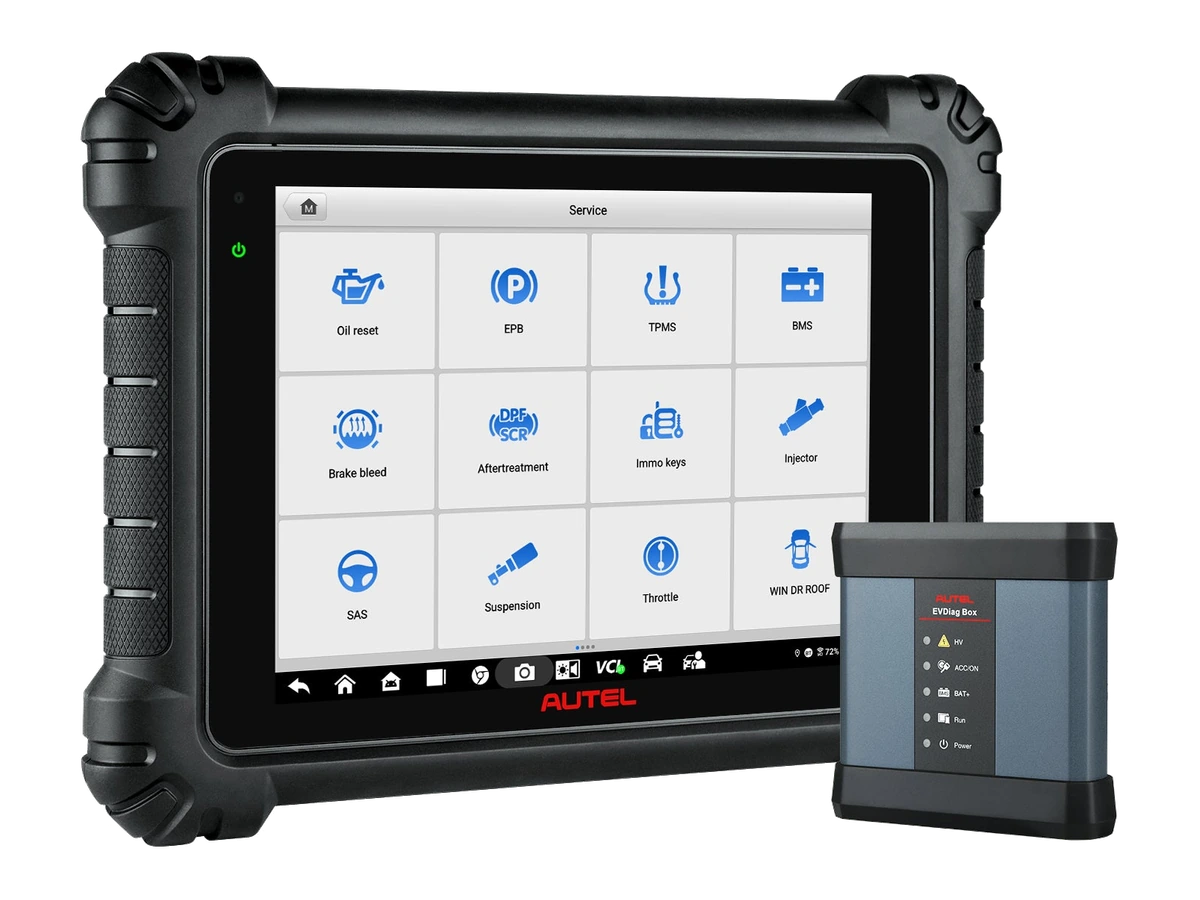
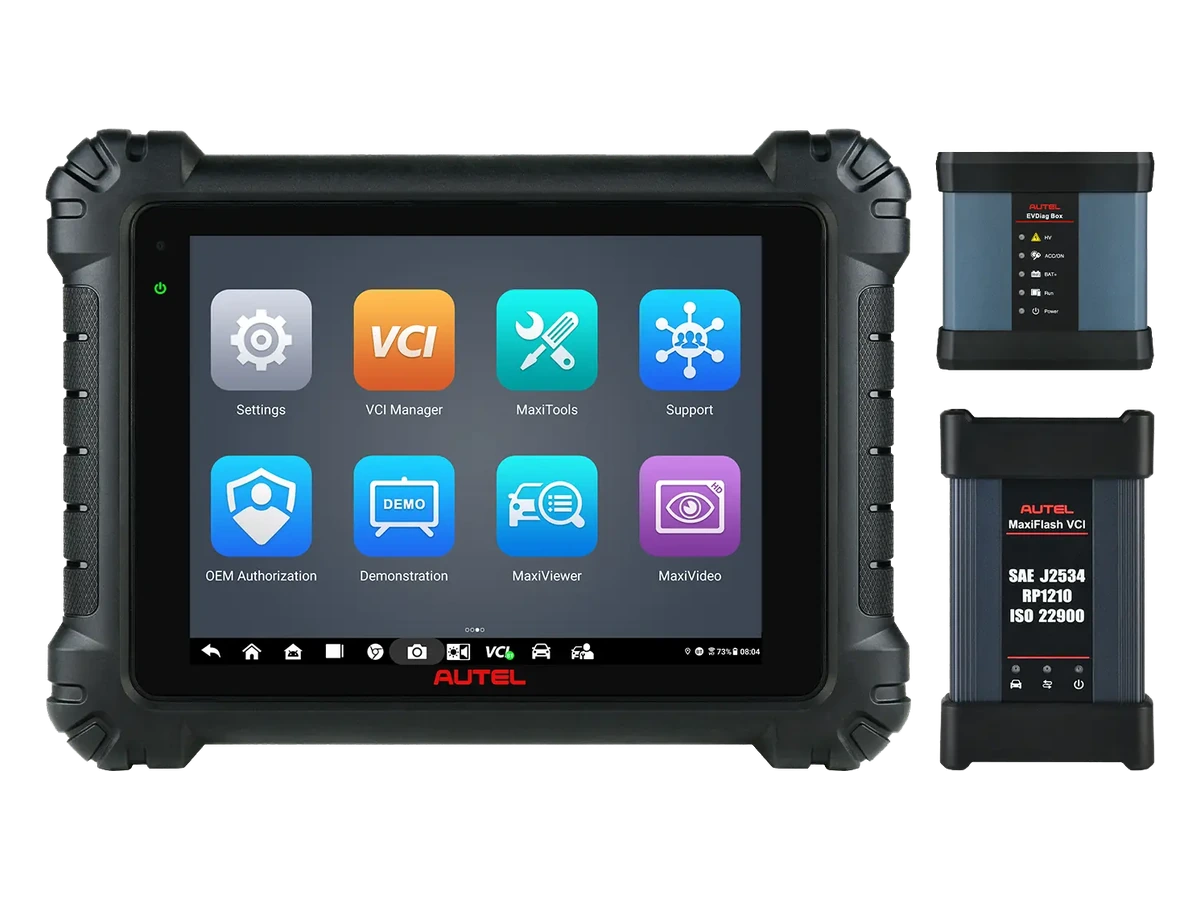 Autel MS909EV.
