How to investigate knock sensor fault? Code, wiring, and installation check
Engine noise and a fault record in the knock sensor circuit are not the same diagnosis. The sensor name in the device is not a direct order for part replacement. After recording the fault description and engine operating conditions, wiring, connector, and mounting are inspected. This guide focuses on the knock detection system in the engine block, distinct from misfire or transmission knock issues.
Otobiltek is the business that sells the Ancel DS600 product linked in this guide.
The ECU / DTC topic was prepared using manufacturer and technical resources; the visual is a genuine catalog photo, not a claim of workshop testing.
Knock detection circuit different from engine misfire, mounting, and oscilloscope limit.
Verification by vehicle, control unit, and process
When model software or technical documentation changes, the relevant process and resource are re-examined.
Decision guide
What does the knock sensor detect?
The sensor converts vibrations in the engine block into an electrical signal. HELLA explains that the control unit can evaluate this information and change the ignition timing for the relevant cylinder in case of knocking combustion. The sensor's notification does not solely explain the cause of all mechanical noises within the engine. Instead of attributing audible external noise to a single device line, the complaint is described separately.
Decision guide
First, record the complete code and event conditions
Do not consider sensor circuit, signal, or range descriptions as the same thing. Record the full code, sub-description, current/past status, and, if available, RPM, load, and temperature information at the time of the event. If the short description translated on the device is unclear, refer to its equivalent in the vehicle manufacturer's service information. The code number alone does not determine which part to purchase.
Decision guide
Why is the mounting surface and tightening information important?
HELLA inspection requires checking the sensor's seating and tightening torque. The connection is part of transmitting vibration to the sensor. If prior engine work was performed, investigate whether the sensor was removed and reinstalled correctly. A universal torque value is not used. Mounting checks are performed according to manufacturer information; random loosening or overtightening is not a diagnostic method.
Decision guide
Evaluate the sensor, connector, and cable separately
Internal fault, cable interruption, short circuit, corrosion, and physical damage are reasons that can be investigated for the same complaint. If electrical measurement is required after visual inspection, the correct diagram and appropriate measurement connection are used. Continuity of the cable is not considered measured from the tablet screen. Unplugging the connector and creating a new code does not, by itself, prove the cause of the old fault.
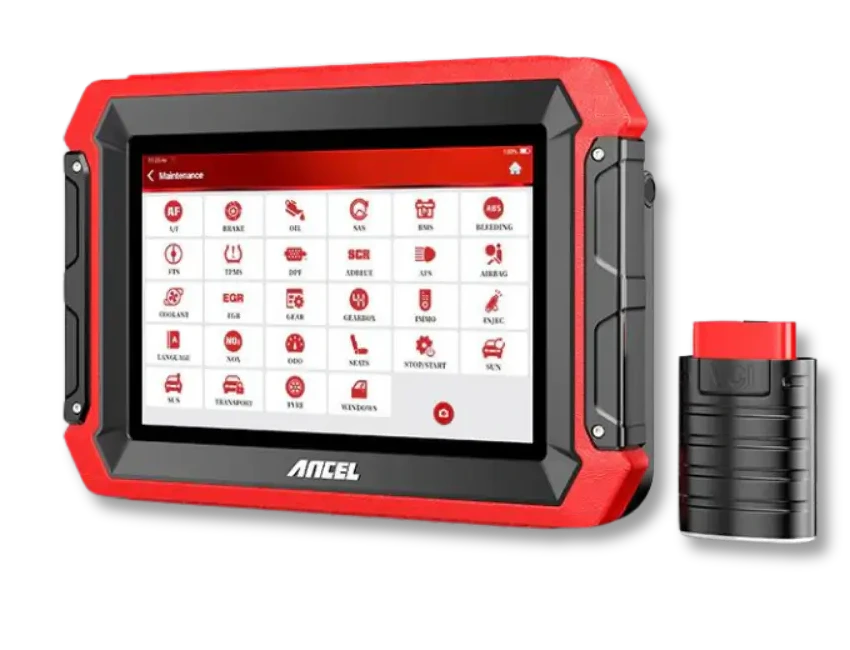
The role of the device in ECU / DTC checks with an actual photo of the Ancel DS600; the image on the screen is not a measurement result.
Decision guide
How is a record starting with DS600 prepared?
DS600's manufacturer description includes system diagnostics and live data. Codes and current parameters of the engine ECU can be recorded on the relevant vehicle; however, the same knock or ignition parameters are not guaranteed for every engine. Include the data to be read with the vehicle identification in your quote. Do not transfer features of DS600BT to DS600; menu photos from different models are not proof of support.
Decision guide
When is an oscilloscope needed separately?
When evaluating the physical form of the sensor signal, an appropriate oscilloscope and connection method are used. HELLA considers this measurement a separate part of diagnostic control. The live data graph on the diagnostic tablet is not an oscilloscope waveform taken from the sensor tip. This distinction is important when purchasing a device: a tablet that performs engine scans does not automatically replace independent electrical measurement equipment.
Decision guide
If mechanical noise persists, do not revert to clearing codes
If there is noticeable abnormal engine noise, power loss, or other serious operating complaints, the vehicle must be evaluated safely. Clearing the code does not fix the physical cause. The noise condition during the initial inspection, the performed checks, and subsequent findings are reported together. Instead of repeatedly testing under high load without verifying the test conditions, follow the vehicle manufacturer's test plan.
Decision guide
Compare the repair result with the initial record
If the wiring harness or mounting is corrected, the work performed is written with its exact name. Then, the necessary vehicle procedure is followed, and the code status is re-examined. If the condition under which the complaint occurred can be safely verified, the old and new records are compared. The outcome is not solely based on 'the light turned off'; engine behavior and any other persistent codes should be included in the delivery notes.
Frequently Asked Questions
Most frequently asked questions by customers
Are a knock sensor fault and engine misfire the same?
No. Although symptoms may appear together, the detected event, circuit, and diagnostic steps are different.
Does tightening the knock sensor fix the problem?
First, mounting and the vehicle manufacturer's torque specifications are verified. Random tightening is not a reliable repair method.
Does DS600 measure the sensor like an oscilloscope?
Reading ECU data and measuring the physical sensor signal with an oscilloscope are separate procedures.
When a code mentions the sensor, is the part ordered?
First, the full description, wiring, connection, and mounting findings are evaluated; the code alone is not a part-ordering decision.