Product information
What is the THINKCAR PLD 212 Turbo used for?
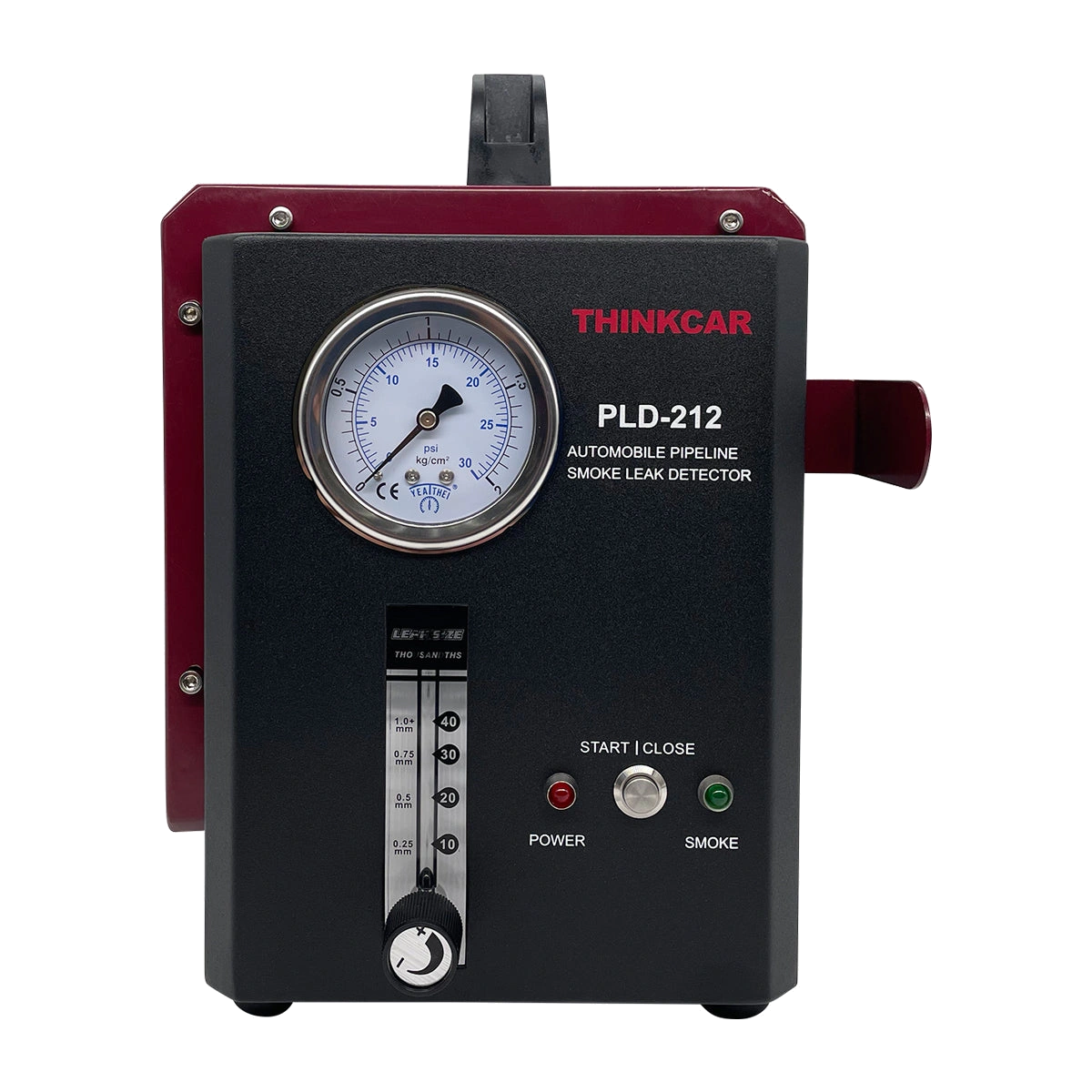
The THINKCAR PLD 212 Turbo is a workshop device that investigates leak locations by introducing air or smoke into compatible automotive pipelines. Thanks to its internal pump, it does not require an external service compressor; it operates with a 12 V DC source. The turbo variant's output pressure is specified as 13–16 psi.
This product is not the low-pressure PLD 212 EVAP offered for fuel vapor systems. It should not be assumed that two different pressure variants exist in the same housing or that it converts to an EVAP device with a button. It does not read fault codes, send commands to the ECU, or measure the mechanical condition of the turbocharger shaft.
It is a separate tool used alongside a diagnostic tool to inspect line sealing.
Vehicle and part coverage
In which vehicles is the THINKCAR PLD 212 Turbo used?
A make-model software list, as found in diagnostic devices, does not apply to this product. Compatibility is determined by the part to be measured, the electrical system, the operating range, the probe or connection method, and the manufacturer's safety limits.
- Vehicle make
- Evaluated not by brand, but by the product's technical measurement or service limit.
- Vehicle model
- Further evaluated if the system to be measured and connection condition are within the technical range.
- Technical limitation
- 13–16 psi Turbo variant, Internal air pump, Air and smoke mode, 12 V DC power supply
- Diagnostic Scope
- Does not include vehicle control unit software or make-specific service menus.
- Measurement range and safe connection conditions are verified from the product's official technical documentation.
Open official sources and coverage connectionsProduct details
What part of the fault does the smoke test indicate?
When there is a complaint of pressure loss in the engine, the fault code alone does not indicate the leak point. There may be a crack in the hose, looseness in the connection, a leak in the intercooler housing, or another control issue. The smoke test allows observation of smoke escaping from a properly sealed section.
Thus, instead of just looking at the code name and replacing parts, the physical sealing of the line is inspected. The source of the observed smoke is recorded; open ends created during the test are not confused with the actual fault. The test result does not provide a definitive conclusion about electrical actuation, sensor accuracy, or the turbo's entire behavior under load.
The result is compared with vehicle procedures and diagnostic measurements.
Product details
What is the 13–16 psi pressure for?
The manufacturer reserves this variant for turbo hose leak detection. The technical range does not mean that all parts of every vehicle can be tested at the same pressure. The allowable pressure of the section to be tested, the points where the line will be sealed, and the position of valves in the vehicle are learned from the service documentation.
The Turbo model is not connected to a system requiring low pressure simply because the connection adapter fits. The flow adjustment knob manages smoke flow; it is not proof that the device has EVAP safety characteristics. The manometer helps observe pressure, while the flow indicator helps track flow status during the test.
The presence of gauges does not replace the vehicle manufacturer's test instructions.
- Variant
- PLD 212 Turbo
- Output pressure
- 13–16 psi
- Flow
- 8–15 L/min
- Power supply
- DC 12 V
- Fluid tank
- 45 ml
- Power cable / smoke hose
- 2 m / 2 m
- Pump
- Internal
- Test mode
- Air or smoke
Product details
Difference between air mode and smoke mode
In air mode, the system's pressure and flow behavior is observed. In smoke mode, a visual trace is added; the technician looks for smoke escaping from appropriate access points. The two modes help inspect the same physical leak in different ways, but the limits of the tested section must be known for the measurement to be accurate.
If a ventilation path that should normally be open is not closed, flow may be observed; this does not always mean a faulty hose. Similarly, smoke escaping from an inaccessible or out-of-sight connection may not be detected.
Proper lighting of the test area, visibility of connections, and the manufacturer's recommended sealing method are more beneficial than just increasing the amount of smoke.
Product details
Service scenario: turbo hose with pressure loss complaint
If there is a loss of power and a pressure-related fault code when the vehicle accelerates, the fault codes and freeze frame data are first saved. The technician disconnects the line specified by the manufacturer as testable and prepares it for smoke testing with the appropriate connection. The hose bend, clamp area, and connection mouth are visually inspected.
If smoke is observed at a specific point, that area is checked for physical damage; a decision is not made solely based on oil traces on the outside of the hose. After repair, the same section is re-tested. Pressure and actuation values under normal operating conditions of the vehicle are also monitored with a diagnostic tool.
The closure of a smoke leak does not alone indicate that no other sensor or control fault exists.
Product details
Service scenario: intercooler and connection points
If there is suspicion of a leak in the intercooler line, it is determined whether the test will cover only the cooler housing or the entire section including hoses. Accessories of the appropriate diameter and shape are used for sealing the ends. A poorly secured plug can create a leak in the test setup itself, rather than in the area being sought.
Housing joints, connection mouths, and accessible hose surfaces are inspected in sequence. The entire cooler is not replaced without observing the source of the smoke. A part that appears sealed when cold may behave differently under heat and load; therefore, the test conditions are documented in the service report.
Pressure limits and test duration are selected according to vehicle procedures.
Product details
Service scenario: post-hose or gasket replacement check
When a new hose is installed, a poorly seated gasket or misaligned clamp can perpetuate the connection leak. Post-repair smoke testing helps visually confirm the placement of the new part. First, the disconnected and reconnected connections are checked, then the appropriate test section is prepared.
The result where no smoke is observed is compared with the previous leak point; after the test, all plugs, adapters, and temporary seals are removed. The vehicle is not started before being returned to its normal connection configuration. In the final check, fault records and relevant live data are reviewed.
This allows the physical repair result and the electronic system's information to be kept in the same service record; a road test that was not performed is not presented to the customer as if it were.
Product details
Initial use, fluid, and connection preparation
The device is placed on a level and secure surface; the fluid tank and connections are prepared in the order specified in the manufacturer's manual. The tank capacity is 45 ml; do not randomly fill it with excess fluid to obtain more smoke. Only use smoke fluid approved by the manufacturer.
Fuel, solvents, or liquids of unknown suitability are not alternatives. The power cable is for 12 V DC supply; this product is not defined as a device to be directly connected to a 24 V battery. Cables and hoses are kept away from hot surfaces, rotating parts, and pinching points.
The vehicle's engine status, valves to be kept open or closed during the test, and connection points are determined by the vehicle's service instructions.
Product details
Main unit and test accessories
The manufacturer's PLD 212 list includes the main unit, power cable, smoke hose, standard cone adapter, filling funnel, inflatable adapter, and hard rubber hose plugs. Eight plugs are shown in the list.
EVAP-specific connections and screwdrivers are listed separately for the EVAP variant only in the manufacturer's documentation; they are not automatically included with this Turbo product. As the number of smoke fluid bottles varies between manufacturer documents, a definitive bottle count is not guaranteed on this page. Upon delivery, connection parts, hoses, and the housing are inspected together.
The diagnostic tablet, vehicle manufacturer software, and external air compressor are not included in this device's sales description. The product operates with its own internal pump.
Product details
Temperature protection and daily maintenance
The manufacturer states that it has overheat protection and the device can shut down when the operating limit is exceeded. This protection does not permit disabling the device's ventilation or continuous forced operation. If abnormal odor, damaged cable, leakage, or unexpected behavior is observed, the test is stopped and the control method in the manual is followed.
At the end of use, the hose and adapters are inspected for physical damage; no spilled liquid is left on the housing. Liquid level, transport, and storage conditions are managed according to the manufacturer's instructions. The safety elements inside the device are not tampered with. The activation of protection does not mean that a fault-free test has been completed automatically.
Product details
EVAP model and fault detection tablet comparison
Turbo and EVAP are options within the same series with different output pressures. The Turbo model is directed towards testing with an appropriate pressure air line, while the EVAP model is selected for applications requiring lower pressure, such as the fuel vapor system. The choice is made according to the instructions of the system to be tested, not based on the word "Turbo" in the model name.
The diagnostic tablet provides fault codes, live data, and supported active tests; it does not physically inject smoke into the pipe. These two pieces of equipment can complement each other in a workshop but do not perform the same function. This product is not a substitute for a tablet for electronic maintenance tasks that do not require a smoke test.
In a multi-brand workshop, the correct method is to first identify the complaint and the system to be tested.