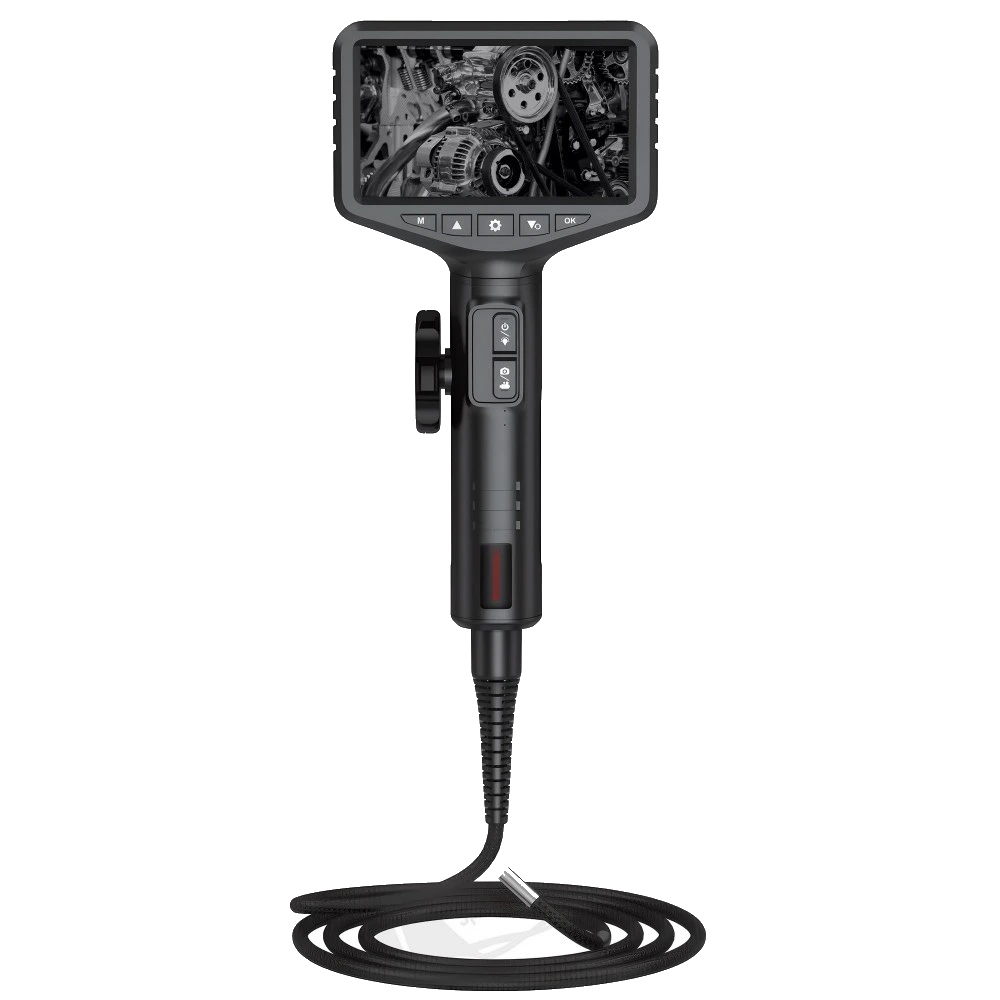
Product information
What does THINKCAR TES402 Joint-Tipped Video Endoscope do?
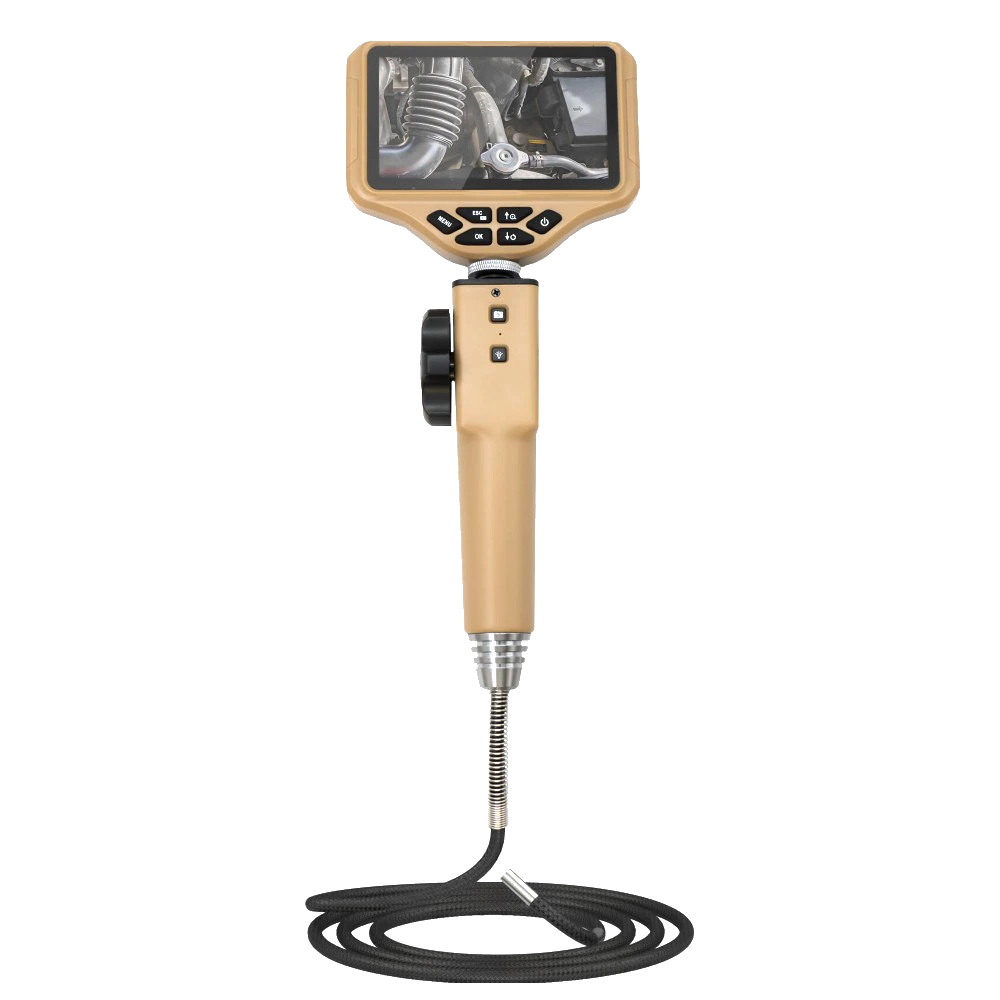
THINKCAR TES402 is a standalone video endoscope that delivers a 6.2 mm diameter camera probe to a hard-to-reach area. It falls within the same broad product family of searches for “automotive endoscope camera,” “snake camera,” “boroscope,” “videoscope,” and “inspection camera.”
The feature that distinguishes TES402 from ordinary fixed-end models is that it can move the last part of the probe 180° bidirectionally with the wheel on the body. This way, one can look at the cylinder wall, the side surface of a pipe or different corners of the HVAC housing without twisting the entire cable.
The device displays the image on a 4.5-inch color screen; It does not require a separate phone, Wi-Fi connection or diagnostic tablet. The 1280 × 720 camera, 100° viewing angle, 2–8 cm focal range and six LED illumination are for examining surfaces at close range.
Photographs and video recording help document the condition prior to disassembly. This product does not read fault codes, make measurements, or determine the cause of the trace on the image alone; The visual finding is confirmed by the appropriate mechanical test and vehicle manufacturer's service procedure.
Vehicle and part coverage
In which vehicles is the THINKCAR TES402 Articulating-Tip Video Endoscope used?
A make-model software list, as found in diagnostic devices, does not apply to this product. Compatibility is determined by the part to be measured, the electrical system, the operating range, the probe or connection method, and the manufacturer's safety limits.
- Vehicle make
- Evaluated not by brand, but by the product's technical measurement or service limit.
- Vehicle model
- Further evaluated if the system to be measured and connection condition are within the technical range.
- Technical limitation
- 6.2 mm camera probe, Bi-directional 180° articulating-tip movement, 950 mm semi-rigid probe, 4.5 inch independent screen
- Diagnostic Scope
- Does not include vehicle control unit software or make-specific service menus.
- Measurement range and safe connection conditions are verified from the product's official technical documentation.
Open official sources and coverage connectionsProduct details
What does TES402 do? How does the endoscope camera work?
An automotive endoscope sends a lighted camera probe to an area that cannot be reached by the naked eye and displays the image on a screen. In the TES402, the camera, illumination and moving tip are located at the end of the same 950 mm probe.
The user advances the probe through the appropriate service opening, turns the directional wheel in small steps according to the image on the screen, and finds the target surface. Due to the 2–8 cm focal range, the lens is not rested on the surface; A distance of a few centimeters is maintained until the image becomes sharp.
This method helps to see inside before disassembly, determine the control point and plan the next mechanical operation. The appearance of scratches, soot, liquid or foreign objects in the image does not alone prove why the part is malfunctioning.
- Video endoscope: inspection device that displays the live image on its own screen
- Articulating tip: mechanism that changes the camera's viewing direction when the probe is inside
- Semi-rigid probe: cable structure that adapts to tight bends while maintaining feed direction
- Recording: possibility to store images of the same area before and after disassembly
Product details
What does the bi-directional 180° articulating tip provide?
With a fixed-tip snake camera, the viewing direction is often changed by rotating the cable or retracting the probe and advancing it to the new angle. The TES402's mechanical direction wheel moves the camera in two directions.
In this way, it becomes easier to turn from the piston top to the cylinder wall, scan the evaporator surface from different angles, or see not only the opposite side of the pipe but also its side wall. The manufacturer's statement "bidirectional 180°" refers to orientation to two sides on a single axis; It does not mean that the probe rotates unlimitedly in all directions.
The wheel should not be forced, the control should not be turned while the tip is attached to a part, and the probe should not be folded beyond its natural bending limit.
- Lens diameter
- 6.2mm
- Steering
- Bi-directional 180°
- Probe length
- 950mm
- Field of view
- 100°
- Focus range
- 2–8cm
Product details
Engine cylinder and piston surface inspection
After the engine is completely stopped and cooled, the vehicle manufacturer's spark plug, injector or related service clearance procedure is applied. The probe is cleaned, the camera light is turned on at low level, and the lens is slowly advanced without hitting the metal surface.
First, there is a large reference surface such as the piston top; The cylinder wall and valve surroundings, which can be accessed by the joint end, are then scanned. Images taken with the same light, distance and angle make comparison easier. Line on the surface; There may be traces of machining, oil film, reflection or damage.
The fluid view alone does not distinguish between oil, fuel or coolant. Compression test, cylinder leak test and manufacturer tolerances are applied separately. The crank or engine is not moved while the probe is inside.
Product details
Use in evaporator, HVAC housing and air duct
When looking for bad odors, poor airflow, or traces of water in the cabin, first check the cabin filter and the HVAC service openings defined by the vehicle manufacturer. The contact, fan and moving blades are closed.
The probe is advanced without getting caught in the wiring harness or fan wheel; The joint end evaporator fins are turned towards the drain direction and the bottom of the box. Moisture, leaves, debris or foreign matter can be recorded visually. Illumination is increased from a low level, as too much LED light on shiny metal blades can turn detail white.
The presence of moisture in the image does not alone prove air conditioner gas leakage or drain blockage; Drainage flow, leakage and pressure checks are also performed.
Product details
Safe inspection of exhaust, pipes and closed mechanical areas
TES402 is only used in areas where safe access is provided and sufficiently cooled. If the exhaust or catalytic structure is to be examined, the vehicle is securely fixed, the temperature of the system is checked and only the service opening allowed by the manufacturer is selected. The probe does not rub against the honeycomb, sensor housing or sharp metal edge.
A blockage-like appearance, crack or foreign body may be noted in the pipe; however, the camera is not a replacement for exhaust backpressure or emissions measurement. Traces of falling parts or liquid between the engine and the fire wall, the chassis profile and the housing can also be found with the same method.
The camera tip is not used as a hook to pull parts.
Product details
4.5 inch screen, recording and LED lighting
The standalone display delivers live viewing without phone pairing or app installation. The manufacturer table lists a 4.5-inch screen, 1280 × 720 camera resolution, and 30 frames per second for the TES402. Six LEDs on the probe tip illuminate the dark space; The light level is adjusted according to the surface reflection.
Photography and video recording can be used to separately document the general location and close detail of the inspected area. The vehicle, date, examined region and working condition should also be added to the registration file in the work order. The image recording is not a measurement report or definitive fault diagnosis.
- Screen
- 4.5 inch color screen
- Camera
- 1280 × 720
- frame rate
- 30fps
- Illumination
- 6 high brightness LEDs
- Logging
- Photo and video
Product details
THINKCAR TES402 technical specifications
The TES series table in the THINKCAR workshop equipment catalog gives the technical values of the model in a separate column from TES303 and TES205. Reference PRO1607 on the Türkiye supply page also lists the same 6.2mm, 100°, 2–8cm, 950mm, 4.5in and three-hour TES402 variant.
This page does not use values seen in other regional listings, such as 5-inch screen, 6.5 mm lens or four hours of use. The model label of the box purchased must be TES-402; On delivery, the housing, probe, display and product label must be matched with the commercial record.
- camera diameter
- 6.2mm
- camera resolution
- 1280 × 720
- Field of view
- 100°
- focal length
- 2–8cm
- Probe length
- 950mm
- Probe temperature
- -10°C to 80°C
- Device temperature
- -10°C to 50°C
- Usage time
- About 3 hours
Product details
What is the difference between TES402 and ES401?
Both models are automotive endoscopes with independent displays and bidirectional moving probe tips; The choice should not be made based on price alone. The verified Türkiye variant of TES402 offers a 4.5-inch screen, 6.2 mm probe, 100° viewing angle, 950 mm probe and approximately three hours of use.
The ES401 supply variant from Otobiltek is listed with a 5-inch screen, 6 mm probe and approximately one meter of metal hose. While TES402's 100° view shows a wider area in a single frame, ES401's slightly thinner probe can provide an advantage in narrow entrances.
The real decision should be made by the entrance diameter, the surface to be viewed, the screen preference and the required angle to the target. Neither product is an OBD diagnostic device.
- TES402: 6.2 mm probe, 100° view, 4.5 inch screen and 950 mm length
- ES401: 6 mm probe, 5 inch screen and approximately 1 meter probe
- Both: bi-directional 180° tip, own display and photo/video recording
Product details
Box, carrying bag and delivery check
Archived actual product photos show the TES-402 box, protective carrying case, device with display, connected probe, USB cable and printed documentation. Functions are not made up for every small part visible in the photo; The exact contents of the delivered batch are checked on the box and the commercial register.
When the device is first turned on, the screen, direction wheel, camera, LED setting and photo/video recording are tried. The probe is inspected for dents, sharp bends, or broken tips. During storage, the tip is placed in the neutral position, the probe is cleaned and dried, and the cable is placed in the bag in a wide loop.
Product details
How should the endoscope image be interpreted?
The endoscope's strength is access; It is not measurement and cause analysis. First, a broad recording is taken showing where the area is, and then a close recording of the suspicious surface is taken. The same trace may look different when the LED level, lens distance and camera angle are changed. If possible, a neighboring cylinder or similar part is compared under the same conditions.
Suspicion of a scratch is confirmed by compression and leak testing, fluid signature by pressure or chemical control, in-exhaust view by back pressure and sensor data. This approach helps reduce the risk of unnecessary disassembly; It does not present the camera as a stand-alone diagnostic device.
Product details
Preliminary inspection of evaporator, HVAC housing, air duct and drain line with THINKCAR TES402 Articulating-Tip Video model
Before using the THINKCAR TES402 Articulated Video model, the test point, physical connection and operating range are recorded. The product is connected in the order in the picture procedure. The first result is written with its unit and operating condition. After the service is completed, a second check is made under the same conditions.
Disconnect connections in a secure order and add both results to the service form.
- Record the test point and operating condition
- Connect the THINKCAR TES402 Articulated Video model according to the official procedure
- Record the initial result with its unit
- Perform the final check under the same conditions