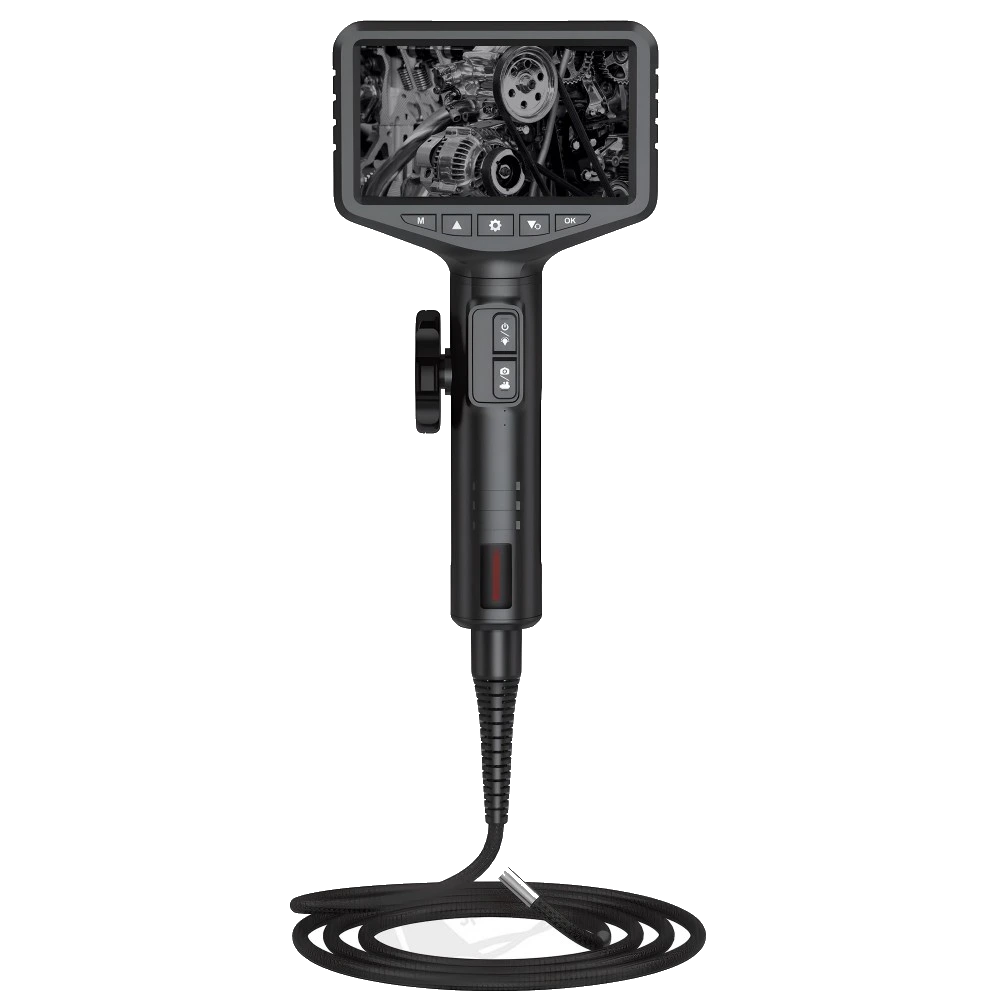
Full view of the handheld unit with screen, directional control, and coiled metal probe.
Full view of the handheld unit with screen, directional control, and coiled metal probe.Articulating tip guided by the control wheel and LED illumination area.View of the 5-inch screen, physical buttons, and illuminated probe together.Side wheel controlling the articulating tip and screen, record, and illumination buttons.Protective case that helps carry the device and accessories together.
Thinkcar · Service Maintenance and Measurement Devices
THINKCAR ES401 Automotive Endoscope Camera
Automotive endoscope camera for visual inspection in cylinders, HVAC, exhaust, and enclosed vehicle areas, featuring a 6mm articulating probe with 180° two-way control and a 5-inch standalone display.
6 mm articulating probe
180° mechanical steering in two directions
5-inch independent screen and 2 MP camera
Cylinder, HVAC, catalytic converter, and chassis cavity inspection
View narrow areas on the screen without connecting a phone or diagnostic tablet; aim the articulating probe tip at the target, and document visual findings with photo or video recording.
What is the THINKCAR ES401 Automotive Endoscope Camera used for?
The THINKCAR ES401 belongs to the class of tools searched as "automotive endoscope camera", "in-car viewing camera", "inspection camera", or "articulating borescope". It is not an OBD device that reads fault codes.
Delivers a 6 mm class camera probe to hard-to-reach areas; the tip of the probe can be moved 180° in two directions using the wheel on the handheld unit. While a fixed-tip snake camera requires rotating the entire cable, the ES401 allows changing the lens direction from the handheld unit.
This structure aids in preliminary visual inspection of cylinder walls, piston surfaces, valve areas, evaporator boxes, catalytic converters, the space between the engine and firewall, and enclosed chassis cavities. The 5-inch screen, adjustable LEDs, and photo/video recording make it easy to see and document the area in service records.
The camera provides an image of a surface; it does not diagnose the cause of oil stains, scratches, carbon deposits, liquids, or foreign objects on its own. Visual findings must be interpreted in conjunction with physical inspection, measurements, and the vehicle manufacturer's service procedures.
What would you buy this for?
Services wanting to perform preliminary visual inspection of the cylinder, piston, and combustion chamber through the spark plug hole
Technicians inspecting the evaporator and HVAC box through the cabin filter or service opening
Mechanics wanting to view the interior of cooled exhaust and catalytic converters through the appropriate service point
Users looking for lost parts and traces between the engine and firewall, in chassis profiles, pipes, or enclosures
Businesses wanting to add their findings as photos or videos to work orders
Measurement and maintenance features
6 mm articulating probe
180° control in two directions
1-meter metal hose
5-inch independent screen
Vehicle and part coverage
What vehicles is the THINKCAR ES401 Automotive Endoscope Camera used for?
A make-model software list, as found in diagnostic devices, does not apply to this product. Compatibility is determined by the part to be measured, the electrical system, the operating range, the probe or connection method, and the manufacturer's safety limits.
Vehicle make
Evaluated not by brand, but by the product's technical measurement or service limit.
Vehicle model
Further evaluated if the system to be measured and connection condition are within the technical range.
Technical limitation
6 mm articulating probe, 180° control in two directions, 1-meter metal hose, 5-inch independent screen
Diagnostic Scope
Does not include vehicle control unit software or make-specific service menus.
Measurement range and safe connection conditions are verified from the product's official technical documentation.
What is an automotive endoscope camera and what does the ES401 do?
An automotive endoscope camera is a service tool that sends a thin camera probe into a vehicle area not visible to the naked eye, transmitting a live image to a screen. The terms "borescope", "videoscope", "inspection camera", "snake camera", and "in-car viewing camera" can be used in the market for the same broad product family.
What sets the ES401 apart is its own screen and the ability to control the probe tip in two directions. Images can be captured without connecting a phone, Wi-Fi, or a separate tablet. This product does not connect to an ECU; it is used for viewing mechanical areas.
The mechanic determines the point to be inspected from the image, but for part replacement or definitive fault diagnosis, they must also apply the relevant measurements and service procedures.
Endoscope camera: a broad product family for viewing narrow and enclosed spaces
Articulating tip: a mechanism that changes the camera's viewing direction while the probe is inside
Independent screen: live image without a phone or app
Recording: the ability to add photos and videos to service findings
Product details
Why is an articulating tip different from a fixed tip?
With a fixed-tip endoscope, changing the viewing angle requires rotating the cable, retracting the probe, or finding a new entry angle. The mechanical wheel on the side of the ES401 steers the tip of the probe left and right.
Instead of just looking at the piston crown inside the cylinder, it becomes more controlled to turn towards the cylinder wall, valves, or injector tip; to scan the evaporator surface in the HVAC box; or to see the side wall inside a pipe. The 180° value in two directions does not mean the probe can be rotated infinitely around its own axis.
The tip should not be forced; maintain a 35 mm bend radius and natural range of motion.
Probe diameter
6.0 mm ± 0.45 mm
Steering
180° in two directions
Bending radius
35 mm
Probe length
Approximately 1 meter
Probe structure
Abrasion-resistant metal hose
Product details
How to inspect engine cylinders, pistons, and combustion chambers?
After the engine has cooled, is secured, and the manufacturer's spark plug removal procedure has been followed, the probe is slowly advanced through the appropriate opening. The lens should not touch the surface; with low LED levels, the piston crown is located, and then the articulating tip is turned towards the cylinder wall and accessible valve areas.
The goal is to document signs like scratches, heavy carbon deposits, liquid accumulation, foreign objects, or unusual surface differences. In forum examples, mechanics use the camera specifically for carbon deposits in GDI engines, comparing injector tips, walls, and piston surfaces.
However, the image alone is not a decision for piston ring, gasket, or compression failure; compression/leak tests and manufacturer tolerances are also required. The engine must never be turned while the probe is inside.
Product details
Use in evaporators, air conditioning boxes, and drain lines
When investigating bad odors, weak airflow, or water stains inside the cabin, the cabin filter and HVAC service openings identified by the vehicle manufacturer can be evaluated. Turn off the ignition and fan; advance the probe without snagging it on wiring harnesses or fan blades.
Turn the articulating tip towards the evaporator fins, drain outlet, and the bottom of the box to look for moisture, debris, leaves, or foreign matter. Keep the LED brightness at a level that does not cause glare on the metal fins.
Visible moisture alone is not proof of refrigerant leaks or drain blockage; drain flow, pressure, and sealing checks must also be performed.
Product details
Catalytic converter and exhaust interior inspection
The manufacturer lists inspection of catalytic converters and hard-to-reach engine components among the use cases for the ES401. The vehicle is safely lifted, the exhaust is completely cooled, and only the service opening approved by the vehicle manufacturer is used. The probe is advanced from a point such as a removed oxygen sensor port, steered without touching the honeycomb surface.
Structures that appear broken, melted, or clogged can be photographed; however, the image does not replace exhaust backpressure, emissions measurements, or sensor data. The probe must not be inserted into a hot exhaust or touch the catalytic surface.
Product details
Inspection between engine and firewall, chassis cavities, and searching for lost parts
The rear of the engine, inside the fender wells, and enclosed profiles and cavities are often not directly visible with a flashlight. The probe is advanced in short steps along a safe path; the articulating tip is kept away from sharp sheet metal edges, cables, and hoses while scanning side surfaces.
Foreign objects, dropped covers, connectors, liquid traces, or loose connections can be visually located. Real-world examples on independent mechanic forums include finding a brake caliper cover in the space between the engine bay and fender.
Product details
What do workshop examples around the world tell us?
In independent automotive forums, users of "borescope" and "inspection camera" particularly mention three common benefits: seeing inside before disassembly, turning with an articulating tip to areas a fixed camera cannot reach, and recording findings with photos. Carbon deposits inside cylinders, wall/piston surfaces, and liquid accumulation are frequently examined topics.
Other examples include blind areas like the space between the engine and firewall, inside fender wells, and cold air intake ducts. These are not laboratory tests or guarantees of fault accuracy for the ES401; they show the types of problems for which real users choose the endoscope camera class.
A trace in one forum photo does not mean the same fault in another vehicle.
Product details
Independent screen, recording, and LED illumination
The 5-inch screen displays the image directly on the device; no phone pairing, Wi-Fi, or separate diagnostic tablet is required. The brightness of the six LEDs around the probe can be adjusted according to the surface being inspected. Start with a low level, as too much light can wash out details on bright metal. Photos and videos are saved to a TF card.
Recording helps document service findings for the customer, the condition before disassembly, or images of the same part at different times. A recording file is not a measurement report; date, vehicle, and inspected area information must be written separately in the work order.
5-inch independent color screen
2 MP camera and 1280 × 720 recording
Six adjustable LEDs
Photo and video recording
Package includes 8 GB TF card support
Product details
ES401 Technical Specifications
The PRO1318 reference in the Turkish supply record lists a 6 mm probe, 20–100 mm depth of field, 70° field of view, one-meter metal hose, and a 3000 mAh battery. The recording resolution is 1280 × 720. An appropriate distance must be maintained between the lens and the target for clarity; the image may become blurry if the camera touches the surface.
The battery is charged via USB-C at 5 V / 1 A. Because probe diameter, lens, and articulation angle may be listed differently on regional ES401 pages, the Otobiltek page uses the 6 mm, two-way 180° version supplied through Sail in Turkey.
Screen
5 inches
Camera
2 MP
Logging
1280 × 720 photo/video
Depth of field
20–100 mm
Field of view
70°
Illumination
6 adjustable LEDs
Battery
3000 mAh
Charging
USB-C, 5 V / 1 A
Product details
Water, temperature, and safe usage limits
IP67 protection applies to the probe and snake tube; the handheld unit with the screen is not waterproof. The main body should not be used in the rain, wash bay, or submerged in liquid. The probe should be cleaned and dried, and not left in corrosive chemicals. The Turkish supply information states an upper air temperature limit of 80°C for the probe and 50°C for the main unit.
These values do not mean the probe can be safely inserted into a running engine or hot exhaust. Belts, fans, chains, and gears must be stopped; surface temperature must be measured, and energy sources must be secured according to service procedures.
IP67 only for probe/snake tube
Screened main body not submersible
Maximum 80°C in air for probe
Maximum 50°C for main unit
Not for use with moving parts while the engine is running
Product details
Package contents, handling, and delivery check
The Otobiltek product package includes the ES401 device, attached probe, USB-C charging cable, TF card, carrying case, and documentation. Upon delivery, check the screen, probe tip, cable connection, direction wheel, LED adjustment, and recording function. The TF card capacity and language of the printed documentation are verified on the box according to the batch.
The protective case reduces the risk of the probe being crushed by sharp bends; the cable is placed in a wide, loose loop. Before placing the probe tip in the case, it should be returned to the neutral position, cleaned, and dried.
Product details
How to correctly interpret endoscope images?
The camera makes inaccessible surfaces visible; it does not measure the cause of the marks it sees. A line on the cylinder wall could be an oil film, reflection, normal machining mark, or damage. Liquid on the piston could be fuel, oil, or coolant. A color difference in the catalytic converter honeycomb does not solely indicate blockage.
Therefore, two recordings are taken, showing the general location first, then the detail; adjacent cylinders or similar parts are compared under the same lighting and angle. Findings are verified with compression and leak tests, pressure measurements, smoke tests, sensor live data, or the manufacturer's physical inspection steps.
This approach uses the camera as a proper visual inspection tool rather than presenting it as a "miracle diagnostic device".
Product details
Difference between fixed-tip, phone-connected, and articulating-tip cameras
Inexpensive phone endoscopes transmit images to an app and often use a fixed tip. A fixed tip may be sufficient for straight pipes or wide openings; however, rotating the cable is necessary to see cylinder walls or behind a part.
The ES401's independent screen reduces setup time, and the articulating tip changes the viewing direction while the probe is inside. However, the one-meter probe does not replace cables several meters long designed for long building installations or ductwork.
Product selection should be based not only on resolution but also on entry diameter, probe length, target viewing angle, recording needs, and operating temperature.
Product details
Evaporator, HVAC box, and drain line inspection with THINKCAR ES401 Automotive Endoscope model
Before using the THINKCAR ES401 Automotive Endoscope model, the test point, physical connection, and operating range are recorded. The product is connected in the order specified in the official procedure. The initial result is recorded with the unit and operating condition. After the service operation is completed, a second check is performed under the same conditions.
Disconnect connections in a secure order and add both results to the service form.
Record the test point and operating condition
Establish the THINKCAR ES401 Automotive Endoscope model connection according to the official procedure
Record the initial result with its unit
Perform the final check under the same conditions
Related pages
Related content for THINKCAR ES401 Automotive Endoscope Camera
Frequently asked questions about the THINKCAR ES401 Automotive Endoscope Camera
Is the correct name for this product an endoscope camera or an inspection camera?
Both terms are used. The most descriptive name is “automotive endoscope camera with flexible tip.” Inspection camera, borescope, videoscope, snake camera, and vehicle interior imaging camera are different names for the same broad search intent.
Where is the THINKCAR ES401 used?
It is used for preliminary visual inspection in cylinders and combustion chambers, evaporator/HVAC boxes, cooled catalytic converters, between the engine and firewall, chassis cavities, pipes, and enclosed mechanical housings.
Does it show pistons and valves inside the engine?
If there is sufficient service access and viewing angle, the piston surface, cylinder wall, and accessible valve circumference can be seen. The visible area depends on the engine geometry; the camera image does not replace compression or leak testing.
Can it be used for catalytic converter inspection?
The manufacturer lists it among catalytic converter usage areas. The exhaust must be completely cooled, and only appropriate service access should be used. The image alone does not confirm back pressure or emission measurements.
Does it require a phone, app, or tablet?
No. The image is viewed on the 5-inch built-in screen; photos and videos are saved to a TF card via the device.
What is the articulation range of the probe tip?
The ES401 version supplied through Sail in Turkey has an articulated tip that can be directed 180° in two directions with a mechanical wheel. The tip should not be forced beyond its natural range of motion.
Is the device completely waterproof?
No. The IP67 rating applies to the probe/snake tube. The main body with the screen should not be submerged in water and should be protected from rain.
Can it be used on a running engine?
No. It should not be used on moving or hot engine parts. The engine must be safely stopped, the surface temperature checked, and no parts moved while the probe is inside.
Does it read OBD fault codes?
No. The ES401 is a visual inspection device; it does not perform ECU fault code reading, live data, active tests, or service resets.
Can it record photos and videos?
Yes. The device saves photos and videos to a TF card. Recording helps document service findings; it is not a measurement report or definitive fault evidence.
Comparison
Similar models to the THINKCAR ES401 Automotive Endoscope Camera
Compare products in the same class with information on usage level, service tasks, and price.
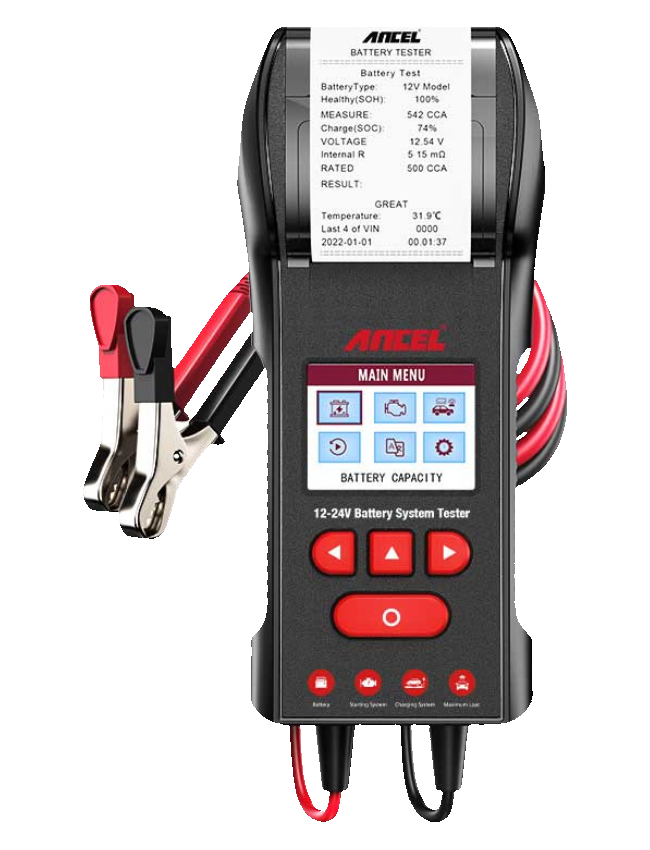
A service-type battery tester that checks battery status, starting, and charging systems in 12V and 24V lead-acid starter batteries, and provides results from its built-in thermal printer.
12V/24V battery test
Starting system check
Charging system check
≈ $1728,490 TL charged · VAT included · import duties excludedOut of stock