Decision guide
Why can the same device be used in four different workflows?
The DS600 is listed on the manufacturer's official product page under titles such as full system diagnosis, bidirectional active testing, maintenance functions, and online or offline coding for specific brands. These functions do not carry a specific industry label. Auto electricians use it for command and circuit relationships, body shops for pre- and post-repair electronic status, inspection businesses for critical module records, and fleet workshops for repeatable acceptance and final check processes.
The value a business derives from the device depends on its daily task list rather than the number of menus. When the makes, model years, and complaints of vehicles received in the last three months are extracted, full system scanning, live data, active test, service reset, adaptation, and coding can be marked as separate task items. The manufacturer's vehicle and function list is examined based on these real-world examples.
A common mistake across the four business lines is reading the fault code on the screen as the final result. The code narrows down the system seen by the control unit; the physical condition of the part, circuit measurements, mechanical inspection, and operating conditions must be evaluated separately. The DS600 provides the data and command layers but does not eliminate other expertise.
A business can standardize the recording language of different teams with a single device. However, each team should not use the same menu for the same purpose. While the inspector's task is to report electronic findings, the auto electrician master derives measurement and repair plans from the same findings.
Decision guide
Transition from code to circuit measurement in auto electrics
The most valuable distinction in auto electrical work is separating the control unit's command from the part's physical response. Bidirectional active testing on the DS600 can send commands to a fan, pump, valve, relay, lamp, lock, or other supported actuator on a supported vehicle. The technician separately observes whether the command is accepted, the status change in live data, and whether the part actually moves.
If the part does not operate with the command, a part order is not placed immediately. Fuses, power supply, ground, terminal tightness, wire continuity, control output, and mechanical binding are measured. If the part operates with the command but the driver's complaint persists, input sensors, automatic engagement conditions, and control strategy are investigated.
Live data is the value seen or calculated by the control unit. To prove the actual physical value at the sensor end, reference voltage, ground, and signal line can be measured; an oscilloscope may be needed for fast waveforms. The tablet narrows down the measurement point but does not replace a multimeter and oscilloscope.
In intermittent electrical problems, common low voltage or communication records from a full system scan are particularly important. Errors seen in multiple modules simultaneously are investigated from a common power supply, ground, and vehicle network perspective before concluding that numerous parts have failed simultaneously.
- Separating Command and Physical Response
- Monitoring Associated Live Data
- Viewing Common Voltage and Communication Codes
- Narrowing Down the Circuit to Measure
Decision guide
Pre-scan and post-scan in body shops
In body and collision repair, electronic recording distinguishes the vehicle's status upon entering the workshop from its status after repair. I-CAR defines the pre-scan as capturing error logs during damage analysis, and the post-scan as identifying new or ongoing error codes during repair, as quality control steps. The DS600 can be used to collect all accessible modules in the same report through a full system scan.
Operations around the bumper, headlights, doors, seats, mirrors, or battery can affect sensor, socket, and cable connections. The initial scan is performed after ensuring safe electrical conditions; if communication is not possible due to damage, it is repeated when the vehicle is secured. New codes, modules that cannot be communicated with, and the response of supported actuators are checked in the second scan.
Scanning and calibration are not the same process. OEM procedures for camera, radar, steering angle sensor, or headlight systems may require specific targets, level ground, measurement distances, test drives, or different equipment. The appearance of a function name in the device menu does not mean all necessary conditions for that vehicle are met.
The system report alone does not explain the scope of the accident. Chassis geometry, paint, panel alignment, physical condition of SRS components, and water tightness are separate inspections. Electronic recording complements these checks; it does not replace them.
- Initial Electronic Record at Service Entry
- Distinction of Codes Generated During Repair
- Post-Assembly Supported Actuator Check
- Scan Separate from OEM Calibration Procedure
Decision guide
Limit of electronic findings in auto inspections
In used vehicle inspections, reading only the engine OBD code can leave ABS, SRS, transmission, steering, and body modules invisible. The DS600 collects current, pending, and history records in accessible control units through a full system scan. This data provides a broader initial picture of the vehicle's electronic status.
If a fault code exists, the vehicle is not automatically considered non-operational; the system, status, reoccurrence condition, live data, and physical findings of the code are read together. Even if there is no code, the vehicle is not definitively considered sound. Recently cleared records, incomplete OBD monitors, modules that cannot be communicated with, or non-electronic mechanical issues may exist.
The inspection report must clearly classify the finding: active code, history code, non-communicating module, warning light status, live data observation, and physical inspection result are separated. Results exceeding the scope of evidence, such as 'Brain clean' or 'electronically flawless,' are not used.
Active test is not the first priority for every vehicle in an inspection. A full system scan and readable report is a more basic need. If further verification is required on electric windows, locks, fans, or any other suitable function, and the vehicle's record supports command, active test can provide additional evidence.
- Critical modules other than the engine
- Active and historical code distinction
- Recording of non-communicating modules
- Distinction between electronic findings and physical inspection
Decision guide
Repeatable acceptance process in fleet workshops
In a small fleet or light commercial vehicle workshop, the device's primary contribution is to apply the same order of acceptance for every vehicle. Driver complaints, dashboard warnings, battery voltage, all-system scan, maintenance needs, and final checks are consolidated into a single work order. This allows checks performed on different days or by different technicians to be compared with the same recording logic.
During periodic maintenance, oil, BMS, DPF, SAS, EPB, or other service functions are only performed if the relevant vehicle and procedure are included in the DS600 function list. The presence of DS600 maintenance functions does not mean the same menus will open on every vehicle in the fleet. Model year, engine, control unit, and software version are added to the recording plan.
When a fault recurs, previous scan and repair notes become important. If it is seen at what mileage, under what load, and after which part replacement a fault code returned, diagnosis does not start from scratch. This benefit arises not from the device's automatic fleet management, but from the business's regular record-keeping.
The DS600 is not a continuously active GPS or CAN telematics system. A separate telematics infrastructure is required for location, driving behavior, fuel consumption, and remote fleet monitoring. The diagnostic tablet is used for deep system checks when the vehicle enters the service bay.
- Standard vehicle intake
- Vehicle-based control of maintenance functions
- Pre- and post-repair scan
- Historical records for recurring faults
Decision guide
Before converting a fault code to a parts order
EPA explains that OBD records a code for a problem detected by the system and directs the technician to the problematic area. The direction is not an order for a part. A low sensor signal may be caused by an open circuit, poor supply, grounding issue, or control unit input, in addition to the sensor itself. A communication code may be related to a module, network line, or low system voltage.
The service sequence consists of code, event condition, associated live data, supported active test, and physical measurement layers. Without these pieces of evidence pointing in the same direction, changing a part solely based on the part name in the code description can lead to returns, repeat labor, and loss of confidence. A specific percentage of savings is not guaranteed; the goal is to strengthen the chain of evidence for the decision.
Deleting codes before the initial recording can result in the loss of event data and the distinction between active/historical status. After the initial scan is saved, deletion, test drive, and re-scan are performed according to manufacturer procedures. Some records may require specific ignition cycles or driving conditions to reappear.
The automatic description on the device screen does not replace the OEM diagnostic tree. The electrical schematic, nominal values, terminal views, and manufacturer's test steps are the technical basis for the repair decision.
Decision guide
Live data, active test, and physical measurement read together
Live data makes input and calculated values visible, while active test makes commands from the control unit visible. Physical measurement verifies the actual voltage, current, resistance, pressure, or movement the circuit is carrying. The function of the three layers is different; the result of one is not substituted for another.
For example, in a fan complaint, engine temperature and fan request are monitored from live data. The fan is activated with a supported command; if there is no movement, supply, ground, relay, motor, and control output are measured. If the fan operates with the command but does not engage automatically, input data and control conditions are investigated.
In an inspection, the same active test only shows that the part is currently responding. In fleet maintenance, the test result is compared with the previous service record. In a body shop, it accompanies socket and physical assembly checks after disassembly and reassembly. The same menu produces different evidence depending on the workshop's purpose.
A safe working area must be prepared when commanding components that are moving, hot, or draw high current. Experimental commands should not be applied to SRS, high voltage, or critical safety systems without the vehicle manufacturer's procedure.
Decision guide
Coding or adaptation after parts replacement
Some part replacements are not completed solely by mechanical assembly. The control unit may need to learn the new part's reference value, match hardware configuration, or complete basic settings. Adaptation, coding, and ECU programming are not the same processes.
The DS600 official page provides offline coding examples for Mercedes-Benz and online coding examples for VW and Audi. These examples do not imply universal software authorization for every brand and model. Part number, control unit, vehicle region, security access, and software version affect the activation of the function.
An auto electrical and fleet workshop can use the supported learning menu for a new battery, throttle body, or other suitable component. In a body shop, operations around the headlights, body module, or sensors may require OEM procedures. An inspection business, however, should report findings without making changes to the vehicle.
Stable vehicle voltage, correct vehicle selection, and uninterrupted connection are required before writing operations. After the procedure, the system is re-scanned; the applied menu, result message, and any returned codes are added to the service record.
Decision guide
Purchase checklist by business type
The selection of the DS600 is made based on the vehicle fleet and work list before the industry name. Auto electricians list the actuators they test most frequently, body shops list the electronic parts they disassemble, inspection businesses list the modules they want to report on, and fleet workshops list maintenance and recurring fault records. These examples are searched for in the manufacturer's current vehicle function record.
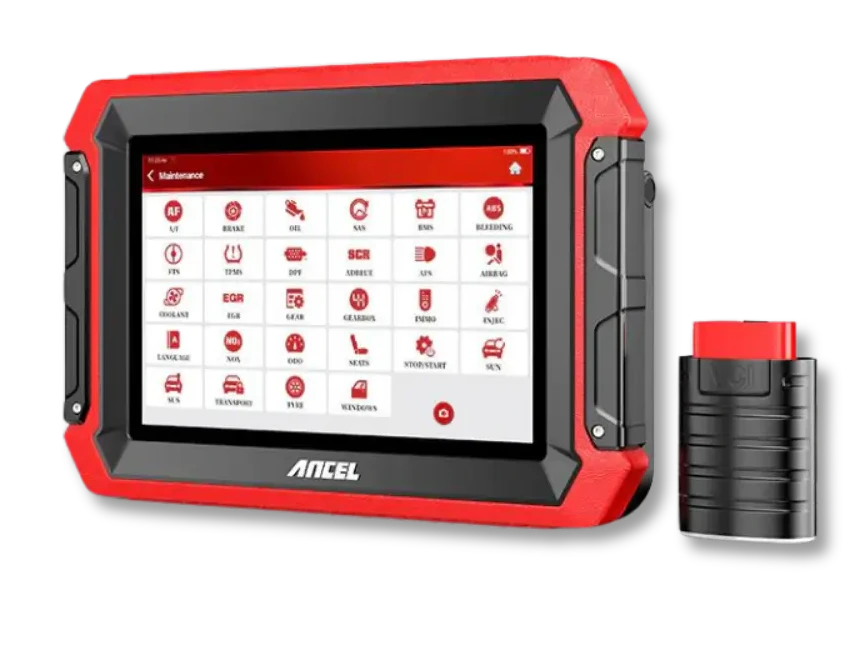
The eight-inch screen displays the entire system tree and live data graphs over a large area. A comprehensive adapter package can be valuable for workshops working with older or brand-specific connections. Conversely, businesses requiring CAN FD, DoIP, or specific next-generation vehicle protocols should not assume DS600 support without verifying it on a vehicle-by-vehicle basis.
Box contents, update duration, security gateway account, and online services are read from the local sales package. Every adapter in the product photo is not automatically included in the delivery list. The offer should show the tablet, VCI, main cable, power equipment, and adapters as separate items.
If the top five expected functions from the device are clearly met, the investment fits into the actual workflow. Choosing a device with numerous unused features is as much an operational cost as buying a cheaper device that doesn't activate the commands needed daily.
- Vehicle list from the last three months
- Top five most frequent operations
- Physical connection requirements
- Writing operations and power conditions
- Update and access policy