Decision guide
What is an active test and how is it applied?
In an active test, the tablet sends bidirectional commands to the supported control unit. The fan, relay, valve, pump, or another actuator found in the vehicle menu is briefly activated; the technician monitors the part's physical response, ECU feedback, and circuit values together. The presence of the test in the list does not solely indicate that the part is mechanically sound. If the command is not applied, supply, ground, cable, driver circuit, and safety prerequisites are measured. For tests involving moving parts, high temperatures, or pressures, the vehicle manufacturer's safety steps are followed.
In a cooling fan test, hands and equipment are kept away from the area of movement; the fan running with the command does not eliminate the need to check the temperature sensor and automatic activation conditions separately.
In a fuel or vapor valve test, ambient ventilation and leak checks are performed. Hearing a sound alone does not measure the valve's flow capacity.
In door lock, lighting, or relay tests, the physical response and the control unit's feedback status are recorded along with the command.
Decision guide
Oil maintenance, EPB, and service reset
An oil service reset restarts the service interval on the indicator according to the vehicle's procedure after physical maintenance is completed; it does not change the engine oil or correct the total mileage. The EPB menu can move the park brake motors to a service position for brake pad replacement on supported vehicles. Closing the system or skipping the caliper procedure before the mechanical work is finished can cause damage. After the procedure, check the brake pedal status, error codes, and the park brake's engage/disengage response.
- Complete physical maintenance first
- Read the vehicle's prerequisites
- Confirm the result on the screen
- Rescan the system
Decision guide
Difference between BMS battery recording and battery test
The BMS service function is used to record the type, capacity, or replacement information of a new battery in the energy management system on supported vehicles. This process does not measure the battery's starting capacity, internal resistance, or health status under load. The correct physical type is selected before battery replacement; charging voltage and related live data are monitored after replacement. A compatible battery analyzer is required for the battery's actual performance. Launch lists the BST-360 model among separately available accessories for use with the CRP 919 MAX; it is not assumed to be included in the standard package.
The technology and capacity of the new battery must match the values permitted by the vehicle manufacturer.
After recording is complete, energy management codes and alternator charging data are read again.
On vehicles where the BMS menu is not found, do not randomly select another model; follow the manufacturer's replacement procedure.
Decision guide
SAS calibration and ABS bleeding
Steering angle sensor calibration re-teaches the zero position after the sensor or steering components are replaced, or after chassis operations specified by the vehicle manufacturer. A level surface, correct tire pressure, and the steering wheel being mechanically centered may be required. ABS bleeding, on the other hand, assists in controllably activating the pump and valves on supported vehicles after the hydraulic system is opened. The device command does not replace the appropriate brake fluid, physical bleeding sequence, and safety equipment. The vehicle should not be driven without checking pedal firmness, fluid leaks, and fault codes after the operation.
Decision guide
DPF function and throttle body adaptation
DPF regeneration is initiated only when vehicle conditions and the manufacturer's service procedure permit. Oil level, fuel quantity, engine temperature, combustible materials around the exhaust, and related fault codes are checked before the operation. It is not possible to safely regenerate a clogged filter by simply accessing the menu; differential pressure, temperature sensors, and ash load are evaluated separately. Throttle body adaptation readjusts the learned position on supported vehicles after cleaning or part replacement. Performing adaptation without addressing air leaks, dirty parts, or mechanical obstructions does not resolve the underlying issue.
During regeneration, exhaust temperature rises; the process is not applied in enclosed areas or near flammable materials.
Differential pressure and temperature data before and after the operation are compared under the same working conditions.
In throttle adaptation, the preconditions on the screen such as ignition, engine temperature, and pedal position are fully applied.
Decision guide
Within what limits is ECU coding used?
ECU coding can manage the existing configuration in supported vehicles and control units, matching after part replacement, or manufacturer-offered options. This does not mean unconditionally uploading new firmware to all control units, enabling hidden features on every vehicle, or performing operations requiring an online manufacturer account. Before coding, existing values are recorded, vehicle voltage is maintained with appropriate power support, and communication is not interrupted. Forcing an operation not in the menu by selecting a different model or year is incorrect.
An active test sends a temporary command to a component; coding may involve a permanent configuration change.
Adaptation recreates a learned value; programming can be a software or data writing process. These terms are not interchangeable.
After coding, the relevant control unit is rescanned, and the modified function is physically tested.
Decision guide
Are all 31 service functions activated on every vehicle?
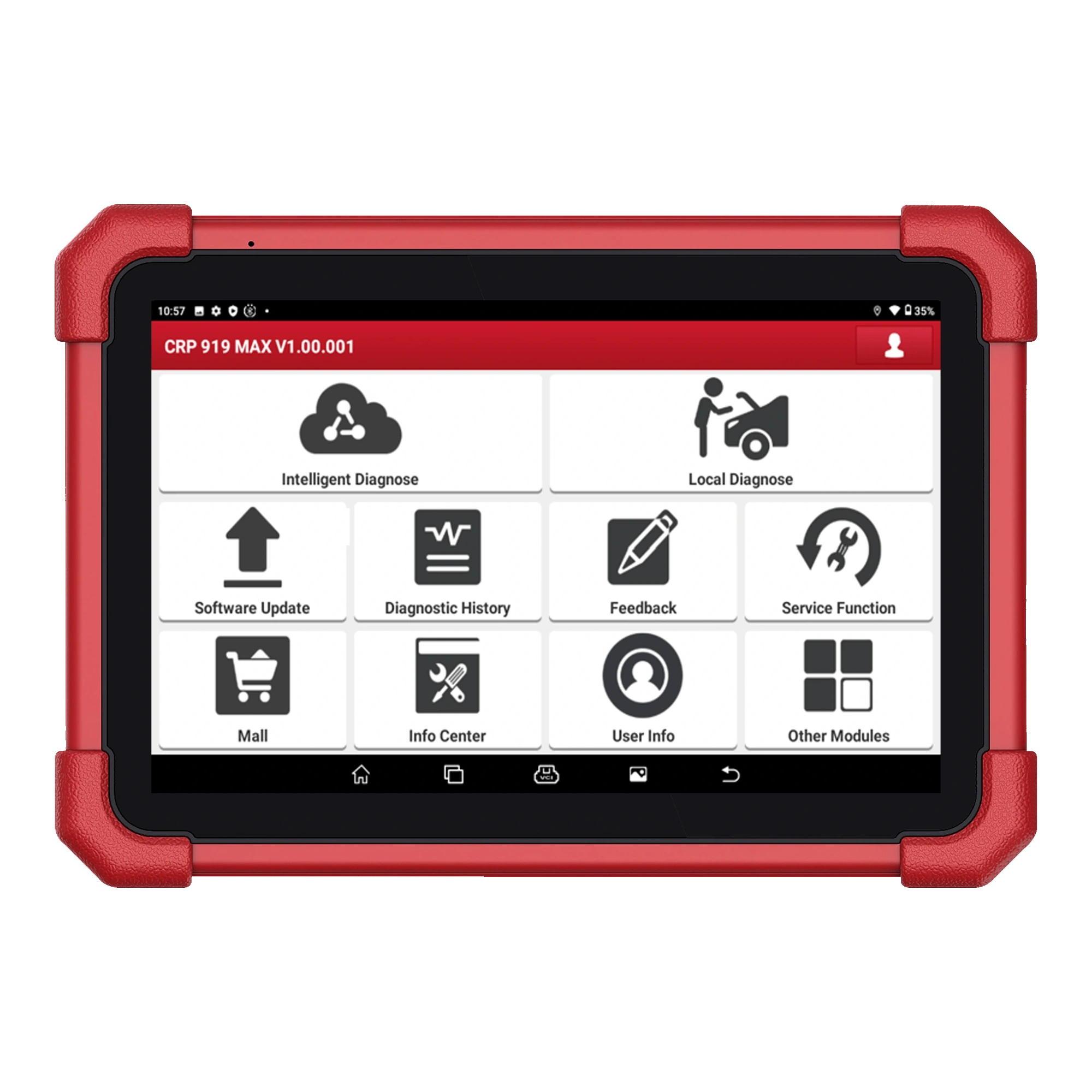
No. While Launch Tech USA and Launch Turkey list 31 service function categories, Launch Europe's current record uses the phrase 35+. This regional or version-dependent numerical difference alone is not proof of broader vehicle support. The official manual states that available tests vary by vehicle manufacturer, model year, and model. An icon on the main screen indicates the device's general capability; enabling the menu on a specific vehicle requires the brand software, control unit, protocol, and sometimes security authorization to work together. Base your purchasing decision on concrete operations for the most frequent vehicles in your service, not just the number.
Decision guide
Pre- and post-operation record keeping
For every active test or service function, the vehicle ID, mileage, initial fault codes, performed operation, and result are recorded. The pre-repair report shows the initial state of the fault; the post-repair report shows returning codes and accessible systems. If live data is to be compared, engine temperature, RPM, load, and test duration are kept the same for both records. This arrangement turns the device's report into actual service proof and allows tracking of previous operations when the same vehicle returns.
Frequently Asked Questions
Most frequently asked questions by customers
Does the CRP 919 MAX perform active tests?
Yes. The official Launch product page lists bidirectional active testing. The available actuator commands vary by vehicle, model year, control unit, and software version.
Does Active Test Definitely Indicate Component Health?
No. The command, physical response, and ECU feedback are examined together; supply, ground, cable, and mechanical condition are checked with measurement devices if necessary.
Do all 31 service functions work on every car?
No. The official guide states that tests vary by manufacturer, model year, and model. The relevant service is checked in the current vehicle and function list.
Does the BMS menu measure battery health?
No. The BMS function performs battery replacement recording or adaptation on supported vehicles. A separate battery analyzer is required for starting capacity and health measurement.
Is TPMS reset the same as sensor programming?
No. The learning or reset menu on the vehicle and the RF programming process of writing an ID to a new sensor are different. Compatible separate hardware may be required for sensor programming.
Are ECU coding and programming the same process?
No. Coding can manage existing configurations; programming may involve writing software or data. The CRP 919 MAX is not presented as a universal programming system for every ECU.
Is DPF regeneration initiated for every blockage?
No. Service regeneration is not initiated without fault codes, oil and fuel status, temperature sensors, differential pressure, and manufacturer safety conditions being met.