Decision guide
What information do STFT and LTFT show?
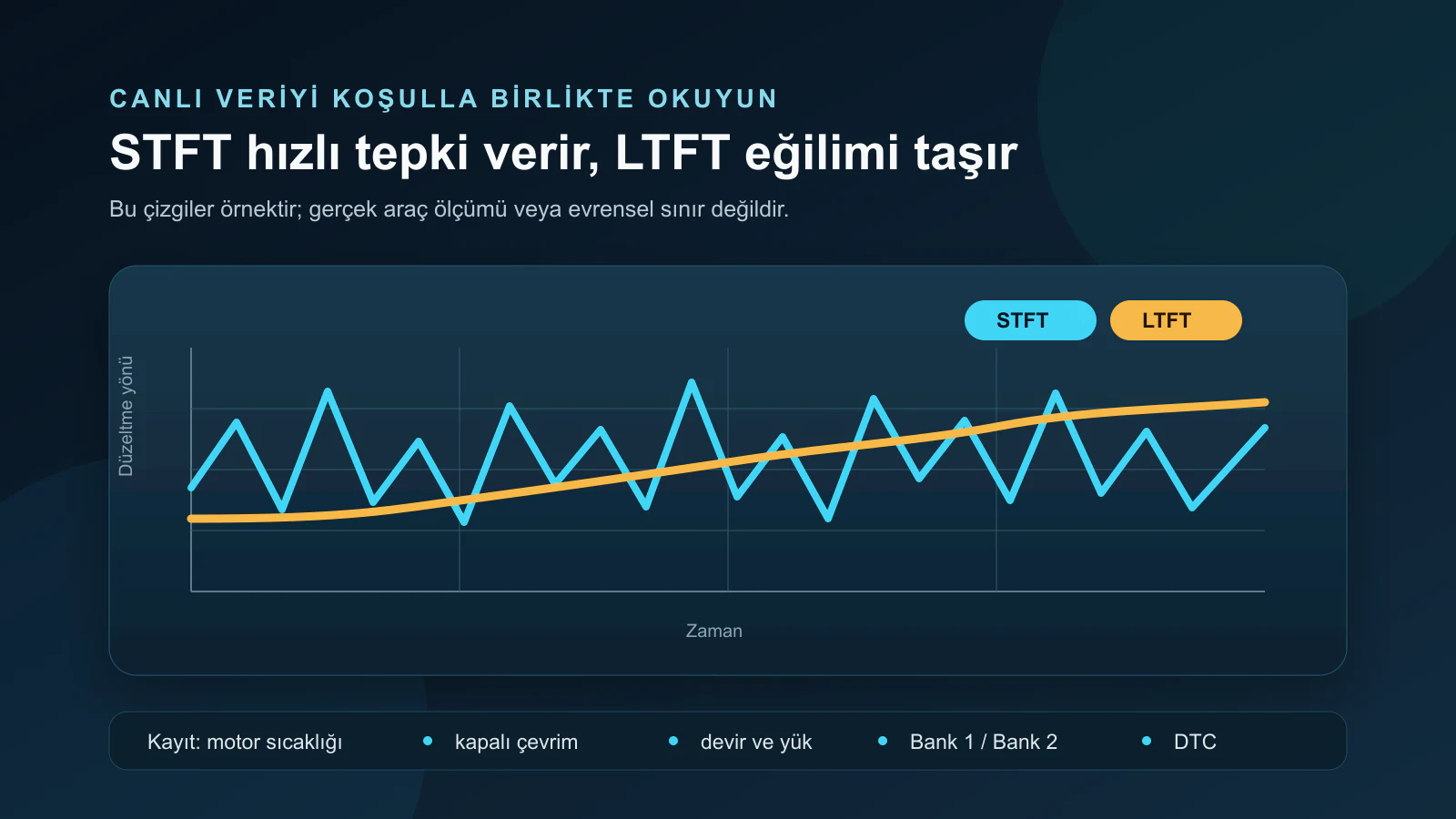
STFT is short-term, LTFT is long-term fuel trim. The control unit tries to maintain the target combustion balance with oxygen sensor feedback and its own operating model, changing the base fuel calculation with these trims. The scan tool can display this correction made by the control unit as a percentage.
The Bosch diagnostic guide defines fuel trim as corrective adjustments made to the base fuel calibration. Short-term trim represents the instantaneous and dynamic response; long-term trim represents the slower adaptation that occurs over time. Therefore, the two rows are monitored simultaneously, but they are not expected to move at the same speed.
The value on the screen is not the direct amount of fuel entering the cylinder. It indicates in which direction and to what extent the control unit is intervening in its own calculation. Injector pulse width, mass air flow, intake pressure, engine speed, load, and oxygen sensor data are different magnitudes; they do not replace fuel trim.
Reading a value is not the same as finding the cause. Unmetered air, fuel supply problems, sensor drift, exhaust leaks, or vapor management system issues can create similar trim directions. First, it is recorded under which condition it occurs, and then the relevant system is tested according to the manufacturer's test sequence.
- STFT: rapid feedback
- LTFT: learned adaptation
- Correction to base fuel calculation
- Not a part diagnosis on its own
Decision guide
Why are short-term and long-term trims monitored together?
STFT moves faster when the operating condition changes. LTFT carries the trend learned by the control unit over time. Looking only at the instantaneous row can lead to mistaking a temporary response for a permanent problem; looking only at the long-term row can lead to missing a change occurring at that moment.
It is natural to see movement in the short-term trim when throttle position, engine load, and RPM change. Instead of taking a single screenshot of the value, a short recording is made at the same operating point. The pattern of fluctuation, oxygen sensor feedback, and whether the engine is in closed-loop are examined on the same timeline.
Long-term trim is valuable for pre-repair recording as it shows accumulated adaptation. However, if the battery has recently been disconnected, learned values have been reset, or the control unit has been serviced, the previous trend may have been erased. A low LTFT value without knowing the service history cannot be considered proof that the system has been trouble-free for a long time.
Adding the two trims can help see the general direction in some diagnostic flows; however, it is not correct to translate the result into a single pass-fail limit that applies to all vehicles. The control strategy, fuel type, engine configuration, and manufacturer thresholds can vary. If official service data is available, the decision limit is taken from there.
Decision guide
What do positive and negative fuel trims mean?
A positive value indicates that the control unit is adding fuel to the base calculation; a negative value indicates that it is subtracting fuel. These signs can be quickly labeled with the words "lean" or "rich," but they do not alone determine which part is causing it.
When a positive trend is observed, an unmetered air leak is not the only possibility. Fuel pressure or flow rate, air measurement data, exhaust line leaks, oxygen sensor feedback, and fuel vapor control can be included in the same evaluation. A trend that becomes apparent at idle and decreases with increasing RPM, and a trend that persists at all loads, do not require the same test sequence.
When a negative trend is observed, the injector is not solely blamed. High fuel pressure, a leaking injector, air measurement deviation, a fuel vapor purge valve, or a different control condition may need to be investigated. Exhaust odor or consumption complaints are not proof of the cause on their own; pressure, sealing, and sensor signals are measured.
The fixed "normal percentage" ranges frequently found on the internet are not binding for all vehicles. The direction of the value, its stability, which bank it is observed on, how it changes at idle and load, DTCs, and manufacturer nominal data are used together. The device's rounding method and sampling rate can also affect minor fluctuations.
Decision guide
How are Bank 1 and Bank 2 rows separated?
A bank refers to one of the engine's cylinder groups. In inline engines, there is usually a single bank; in V-engines, Bank 1 and Bank 2 may show separate trims. The physical side of Bank 1 is not guessed; the engine's cylinder numbering is checked.
Bank 1 is the group containing cylinder number one. Naming it left or right from the front of the vehicle by rote is incorrect; the engine's placement and the manufacturer's cylinder order are decisive. Sensor and bank matching cannot be done without consulting service documentation or reliable part placement information.
Similar changes in both banks may suggest a common air intake, common fuel supply, or a condition related to operating conditions. A deviation in only one bank may prioritize the intake, injector, exhaust, or sensor circuit specific to that bank. These are diagnostic hypotheses; measurement is required for part replacement.
Seeing a sensor name like B1S1 on the scan tool is not the same as the fuel trim row. B1S1 usually refers to the upstream oxygen sensor on the relevant bank. Sensor signals, fuel trims, and closed-loop status are recorded as separate parameters.
Decision guide
Why are closed-loop and engine temperature important?
Before interpreting fuel trim, it should be observed whether the control unit is using closed-loop feedback. The control mode may change during cold starts, high loads, fuel cut-off, or certain fault strategies. Comparing the same percentage under different operating modes is misleading.
EPA technical resources explain that closed-loop control uses oxygen sensor information to keep the air-fuel ratio around the target. In open-loop, the control unit may rely on specific maps and conditions. Look for a line like Fuel System Status, CL, or Closed Loop in the device menu; the translation may vary depending on the device software.
Engine coolant temperature, air temperature, and time since start are added to the recording. A thermostat problem or temperature sensor deviation can affect the engine's transition to its expected operating state. The temperature gauge on the dashboard is not used for precise measurement; live data and physical measurement, if necessary, are compared.
Before testing, existing and pending fault codes and freeze-frame data are recorded. Clearing codes or resetting learned values can change the diagnostic context. Resetting should not be done before the initial measurement is completed; otherwise, information about the condition and duration of the trim generation may be lost.
- Observe closed-loop status
- Record engine temperature
- Obtain data before clearing codes
- Repeat the same operating condition
Decision guide
How is idle and elevated RPM comparison performed?
Comparison is made after the engine reaches a safe operating temperature and closed-loop is confirmed. First, STFT, LTFT, RPM, load, air measurement, and oxygen sensor data are recorded at idle. Then, if the manufacturer's procedure allows, the vehicle is recorded again at a stable and safe elevated RPM.
The initial recording provides at least two repeatable operating points. The parameter list is not unnecessarily expanded; a large number of PIDs can reduce the refresh rate on some devices. Along with STFT and LTFT, engine speed, calculated load, coolant temperature, MAF or MAP, and closed-loop status provide the basic context.
If the trim is only apparent at idle and decreases with RPM, a leak that becomes more significant at low airflow may be investigated. If the trim increases with RPM and load, the behavior of the fuel supply or air measurement under load may be examined. These patterns are not definitive conclusions but rather guides for selecting the next measurement.
The screen is not watched while the vehicle is in motion. If the device supports data recording, recording is started beforehand and reviewed after the drive; if necessary, a second person operates the device. If traffic safety and manufacturer test conditions are not met, rely on stationary workshop checks or use a suitable test environment.
Decision guide
What checks are sequenced for fuel trim deviation?
The correct sequence categorizes the screen value into possible cause categories and tests each category with measurement. Air intake, fuel supply, sensor feedback, exhaust sealing, and vapor management system are considered together. Simply replacing the part named in the fault code is not a reliable method.
In case of suspected unmetered air, intake hoses, manifold connections, PCV line, and related seals are inspected visually and with an appropriate leak test. Using flammable spray carries a fire risk and is not a controlled measurement. If a smoke test is to be performed, follow the equipment manufacturer's safety instructions and the vehicle manufacturer's procedure.
On the fuel side, pressure and hold tests are performed with the manufacturer's specified connection and safety steps. If injector balance or leakage is suspected, vehicle-specific tests are used. The system is safely depressurized before opening the pressure line; eye protection, ventilation, and fire precautions are not neglected.
On the sensor side, MAF/MAP, oxygen sensor, and temperature data are verified with nominal values, circuit checks, and an oscilloscope if necessary. A sensor producing a value on the screen does not mean it is measuring correctly. Supply, ground, signal integrity, and mechanical condition are checked together.
- Intake manifold and PCV
- Fuel pressure and injector
- MAF/MAP and oxygen sensor
- Exhaust and vapor management system
Decision guide
How is fuel trim verified after repair?
The pre-repair recording is saved, the identified physical cause is addressed, and a new recording is taken under the same operating conditions. Resetting learned values is only done if required by the manufacturer's procedure. Values observed immediately after resetting do not prove the vehicle has completed its adaptation to the new condition.
The initial and final recordings should be at the closest possible matching engine temperature, closed-loop status, RPM, and load points. This better distinguishes whether the change is due to the repair or a different test condition. DTCs, freeze-frame data, and fuel trim reports can be added to the work order.
EPA test studies show that short-term and long-term trims are monitored throughout driving cycles, and repeated operation may be necessary for adaptation to new fuel or conditions. Therefore, manufacturer-allowed adaptation and verification times are used instead of a single idle moment. No general mileage or time promise is made.
Even if the trim trend returns to normal, the mechanical repair is visually and physically inspected, leaks are confirmed to be absent, and no new codes are generated. The goal is not just to reduce the number but to eliminate the cause of the fault and demonstrate that the engine has stable control at different operating points.